
Accounts Payable vs Accounts Receivable
Accounts payable vs accounts receivable explained for Australian SMEs — clear definitions, cashflow impact, KPIs, aging analysis and practical tactics
Ansh Malhotra

Australian SMEs should prioritise accounts receivable first: invoices were paid an average of 22.9 days after issue in the June 2026 quarter, with another 6.0 days late, while supplier invoices were paid in an average of 26.2 days across industries. Accounts payable protects cash, but faster collections usually move more money into the bank than delaying an already-controlled payment run.
It's 6:47am, payroll clears in three days, and the bank balance looks comfortable until you subtract the supplier bills, tax obligations and wages already committed. Four weeks of unpaid customer invoices sit in the accounting system, technically recorded as revenue and practically unavailable for rent, stock or growth.
That's the situation many Australian founders face. The business can be profitable, sales can be strong, and the owner can still spend the morning deciding which payment gets made first.
Accounts payable, or AP, is the money leaving the business. Accounts receivable, or AR, is the money that should be coming in. They're often managed as separate bookkeeping functions, but cash doesn't care about the org chart. It cares about the gap between customer payment and supplier payment.
My view is straightforward: AR is almost always the bigger working-capital lever for an Australian SME. Xero Small Business Insights estimated that late payment delays cost Australian small businesses about $1.1 billion per year, and earlier research found 48% of invoices issued by Australian small businesses in 2021 were paid late (Xero's guide to late payments in Australia). If customers pay slowly, tweaking an AP run rarely solves the underlying shortage.
Practical rule: Collect money you've already earned before you spend time negotiating money you already owe.
That doesn't make AP unimportant. Disciplined AP protects the cash released by AR without damaging suppliers, losing favourable terms or triggering a cut-off. The useful question isn't “What's the difference between accounts payable and accounts receivable?” It's “Which lever frees the most cash, and how do I pull it without creating a bigger problem?”
For a broader profit-improvement perspective, Glenis Gassmann's guidance on profit improvement is useful because it treats cash and operational discipline as connected decisions rather than isolated accounting tasks.
Table of Contents
The Cash Moment Every Australian Founder Recognises
The bank balance is only half the story
A founder opens the dashboard and sees cash in the account. Then she checks the payment queue. A major supplier is due, payroll is approaching, and several customers have missed their agreed dates. The balance is real, but it isn't fully available.
That tension comes from two ledgers moving at different speeds. AR records money customers owe you after you've delivered the work. AP records money you owe suppliers and other creditors. When AR slows, the business finances customers. When AP runs too early, the business finances suppliers as well.
The June 2026 Xero data shows some improvement in Australian small-business payment timing, but it still leaves a meaningful collection gap. In that quarter, invoices were paid 22.9 days after issue on average and 6.0 days late, compared with 24.2 days after issue and 6.9 days late in the March 2026 quarter (Xero Small Business Insights data). Improvement isn't the same as cash arriving when you need it.
A separate Australian Payment Times Reporting Scheme update found that reporting entities paid small-business suppliers in an average of 26.2 days, while only 68.1% of small-business invoices were paid on time (Payment Times Reporting Scheme update). That creates a practical mismatch. Your customers may pay late while your suppliers expect payment according to terms.
Why AR comes first
A dollar collected from an overdue invoice is cash already attached to a completed sale. It can fund wages, stock, tax or debt reduction without requiring another sale. By contrast, extending a supplier payment preserves cash temporarily, but it can also create friction, late fees or a weaker relationship.
That's why I'd rank the levers this way:
Collect overdue AR.
Prevent new AR from becoming overdue.
Use agreed AP terms fully.
Renegotiate AP terms with important suppliers.
Consider selective payment timing only after the first four are under control.
The next sections put the bookkeeping definitions in plain English, connect both ledgers through the cash conversion cycle, and turn the analysis into a practical plan. You don't need a large finance department. You need a visible aging report, clear owners and the willingness to make collection calls before the problem becomes urgent.
What AP and AR Actually Do in a Business
Accounts payable is the record of bills your business has received but hasn't paid. That includes supplier invoices, software subscriptions, contractors, rent-related charges and other operating obligations. On the balance sheet, AP is a liability, because the business owes the money.
Accounts receivable is the record of invoices your business has issued for goods or services already delivered but not yet paid. It's an asset, because the business expects to receive the money. An unpaid invoice may support reported revenue, but it doesn't pay the wages until the customer remits the cash.
AP vs AR at a glance
Dimension | Accounts Payable | Accounts Receivable |
|---|---|---|
Who owes whom | Your business owes suppliers or service providers | Customers owe your business |
Cash direction | Cash flows out | Cash flows in |
Balance-sheet classification | Liability | Asset |
Main ledger activity | Receive, approve and pay bills | Raise, monitor and collect invoices |
Primary KPI | Days Payable Outstanding, or DPO | Days Sales Outstanding, or DSO |
Main risk | Late fees, supply interruption or damaged terms | Cash shortages, disputes and bad debt |
Founder's decision | When can we pay without breaking terms? | How quickly can we collect what we've earned? |
The direction matters. A larger AP balance can mean the business is preserving cash by using agreed supplier credit. It can also mean invoices are overdue and the company is under pressure. A larger AR balance can reflect growth, but it can equally show that customers are taking too long to pay.
Don't confuse AR turnover with sales turnover. Revenue measures what the business sold. AR performance measures how efficiently that sale becomes cash. A business can increase sales and make its cash position worse if it gives longer terms or fails to chase overdue invoices.
The working-capital framing
AP is mostly a timing decision inside your control. You can schedule payment runs, approve bills promptly, negotiate terms and avoid paying before the agreed date. AR is a collections discipline problem that partly sits with the customer. You can invoice promptly, set terms, request deposits, clarify disputes and follow up, but you can't force a healthy customer to change its internal payment process without a clear commercial conversation.
The strongest finance teams manage the two together. They don't use AP delay to hide weak AR, and they don't chase customers aggressively while paying suppliers earlier than necessary. They manage the timing of both sides against the cash position.
How AP and AR Move Cash Using the Cash Conversion Cycle
A business can be profitable on paper and still feel short of cash. The cash conversion cycle, or CCC, shows why by turning inventory, receivables and payables into one working-capital view:
CCC = DIO + DSO − DPO
DIO measures how long cash sits in inventory or work in progress before sale. DSO measures the days between invoicing and customer payment. DPO measures the days between receiving a supplier invoice and paying it. The formula and its Australian SME application are set out in this cash conversion cycle guide for Australian SMEs.

Read the formula as a cash sentence
A longer DIO leaves more money in stock or unfinished work. A longer DSO leaves your cash with customers. A longer DPO keeps cash in your bank for longer, provided you pay within agreed terms and protect supplier relationships.
Consider a business with:
DIO of 30 days
DSO of 48 days
DPO of 28 days
Its cash conversion cycle is 50 days, calculated as 30 plus 48 minus 28. Cash stays tied up in operations for roughly 50 days before becoming available again.
The dollar impact depends on annual operating spend, revenue mix and the balances supporting the cycle. Skip generic cash estimates. Calculate your own position from inventory, receivables and payables:
DSO: average accounts receivable divided by annual revenue, multiplied by 365.
DPO: average accounts payable divided by cost of goods sold, multiplied by 365.
CCC: DIO plus DSO minus DPO.
Use the cash conversion cycle framework from Nexist to connect these measures to your balance sheet.
Which change deserves attention first
For most Australian SMEs, AR is the first cash lever to inspect. A five-day reduction in DSO releases cash by shrinking the receivables balance needed to support the same revenue. The work has already been delivered and invoiced, so collection usually creates cash without asking a supplier to carry more of your working capital.
A five-day increase in DPO can preserve a similar amount of cash relative to the relevant supplier spend, but the supplier must accept the timing. Use agreed terms, not silent lateness. Paying earlier than required wastes cash, while paying late can threaten supply and trust.
Start with invoice accuracy, clear payment instructions, fast dispute resolution and a named owner for overdue accounts. Then review supplier terms and payment runs. For more practical ways to boost your cash flow with these strategies, fix AR first and use AP discipline to protect the cash you recover.
AP and AR Compared on the Levers That Matter
The bookkeeping distinction is simple. The cash decision is not.
AR converts completed work into bank balance. AP controls when cash leaves the bank. Both matter, but they don't carry the same starting priority for most Australian SMEs. If overdue invoices are sitting in the ledger, the founder should not spend the first week optimising supplier payment batches.
AP vs AR across the five levers that move SME cash
Criterion | Accounts Receivable, AR | Accounts Payable, AP |
|---|---|---|
Purpose | Collect cash for delivered goods or services | Settle obligations for goods or services received |
Cash direction | Brings cash into the business | Sends cash out of the business |
KPI that moves cash | DSO, overdue balance, collection rate and dispute age | DPO, payment accuracy and terms utilisation |
Urgency profile | High when invoices are overdue, disputed or concentrated in one customer | High when a critical supplier, payroll-related obligation or statutory payment is approaching |
Downside risk | Bad debt, customer conflict and wasted collection time | Late fees, supply interruption and damaged supplier trust |
Rank the lever before you optimise it
First, reduce DSO. Faster collection usually creates the cleanest cash release because the business has already delivered the work and raised the invoice. Start with invoice accuracy, payment instructions, dispute resolution and a named person responsible for follow-up.
Second, prevent avoidable delay. Many slow accounts aren't refusing to pay. They're waiting for a purchase order, corrected tax details, delivery confirmation or approval from someone who never received the invoice. Fixing those issues improves collection without demanding a favour from the customer.
Third, use DPO deliberately. Take the payment time you've agreed, not less. Negotiate longer terms with suppliers that can support them, and never pretend that an overdue bill is an AP strategy.
Early-payment discounts can work when the implied return beats the business's cost of capital. Otherwise, paying early is an expensive way to feel organised. Supplier negotiation belongs in the same category. Ask for better timing, but don't trade away supply reliability for a short-term bank balance.
The hidden AR risk is bad debt. The hidden AP risk is losing the supplier terms that made the business viable. A strong founder knows which risk is present before pulling either lever.
Reading and Using an Aging Report to Chase Smarter
An aging report is the fastest way to stop treating every debtor equally. Pull it from Xero, MYOB or QuickBooks, then sort open invoices by age and customer. You're looking for concentration, not just a total balance.
Use consistent buckets:
Current: Not yet overdue.
1 to 30 days overdue: Early collection action.
31 to 60 days overdue: Active investigation and escalation.
61 to 90 days overdue: High-priority recovery.
90-plus days overdue: Formal recovery decision.
The report should show customer name, invoice date, due date, amount, days overdue, contact owner and dispute status. A large current balance may be normal for a growing business. A smaller balance spread across 61-plus days can consume more management attention and carry greater recovery risk.

Set a cadence that gets firmer with age
Invoice status | Action | Owner |
|---|---|---|
Due soon | Confirm the invoice arrived and payment details are correct | AR owner |
Day 1 overdue | Send a polite reminder with the invoice attached | AR owner |
Days 7 to 14 overdue | Email, then call to identify the blocker | Founder or account owner |
31 to 60 overdue | Agree a payment date and resolve disputes in writing | Founder and AR owner |
61-plus overdue | Consider stopping supply, formal demand or external recovery advice | Founder and adviser |
Use a simple opening line: “Hi [Name], I'm checking that invoice [number] reached the right person and asking when we can expect payment.”
Don't wait for the next month-end close. Review the report weekly, keep disputes separate from ordinary late payments, and make the account owner responsible for the conversation. If the customer says the invoice is wrong, fix the issue quickly. If they say it's approved, obtain a payment date.
A tool comparison can help if reminders are inconsistent. This Truespeak invoice software comparison is relevant when you're assessing automated follow-up options. For the reporting mechanics and interpretation, use Nexist's accounts receivable aging report guide.
The report should change behaviour, not merely produce a prettier chart.
AP as a Liquidity Lever Without Burning Supplier Trust
Cash is tight, invoices are due, and a supplier is waiting. AP can create breathing room, but only if you manage payment timing inside the commercial agreement. AR usually brings the larger immediate cash opportunity. AP protects that gain by stopping avoidable cash from leaving early and keeping supply reliable.

Four moves worth making
Renegotiate terms before cash gets tight. If a supplier expects payment within seven days or at month-end, ask whether 30-day or 45-day terms from invoice are available. Do not start with a price-cut request. Explain that the proposed timing better matches your operating cycle, and confirm the agreement in writing. Nexist's supplier negotiation guidance can help you prepare that conversation.
Run controlled payment batches. A weekly payment run creates one approval point, reduces random outflows and improves the cash forecast. Pay according to agreed terms, not when every bill arrives. Keep urgent exceptions visible, with a reason and an approver.
Use early-payment discounts selectively. Take the discount only when its value exceeds the overdraft rate or other cost of capital. If cash is constrained, retaining liquidity can matter more than reducing the invoice total.
Centralise purchasing. Duplicate subscriptions, unapproved contractors and fragmented buying add noise to AP. Give purchasing one owner, set an approval threshold and review recurring bills. That removes waste without asking suppliers to change their terms.
The trust rule is simple:
Never stretch DPO on a supplier you cannot afford to lose.
A late payment to a non-critical vendor may be manageable. A late payment to the supplier holding your stock, materials or key service access can stop delivery at the worst time. Rank suppliers by operational impact, pay priority partners within the agreed terms, and tell them before the due date if a delay is unavoidable. Silence turns a cash-management decision into a trust problem.
A Practical 90-Day Plan to Plug the Cash Leaks
The bank balance is tight, customers are slow to pay, and supplier bills keep arriving. Start with AR because it usually offers the larger immediate cash opportunity. Once collections are more predictable, tighten AP, then assign owners so the improvement survives a busy month.
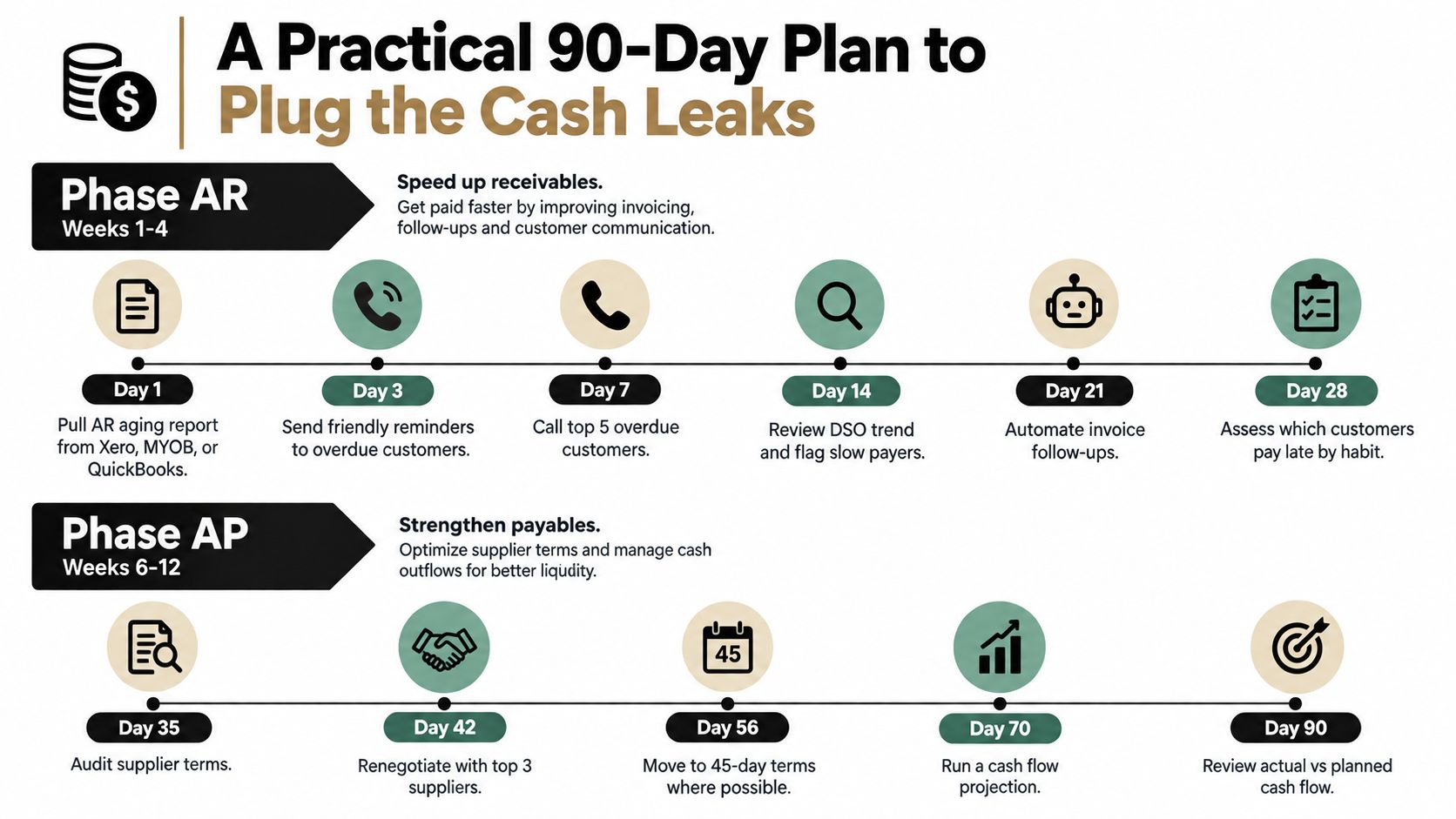
Days 1 to 28 focus on receivables
Day 1: Export the AR aging report from Xero, MYOB or QuickBooks. Add the customer owner, dispute status and promised payment date. Without that context, the report shows balances but not the action required.
Day 3: Send reminders for every overdue invoice. Attach the invoice, confirm payment details and remove administrative excuses.
Day 7: Call the five most important overdue customers yourself. Ask what is blocking payment and secure a date, not a vague promise.
Day 14: Review the DSO trend and identify habitual slow payers. Update sales and onboarding so payment terms are agreed before work starts.
Day 21: Automate follow-ups for upcoming and overdue invoices. Keep personal calls for material or sensitive accounts, where a conversation can resolve the issue faster.
Day 28: Identify customers who pay late by habit and change commercial terms for new work. Deposits, staged billing or shorter terms may suit accounts with repeated collection risk.
Days 35 to 70 tighten AP
Audit supplier terms and find bills paid earlier than required. Ask key suppliers for net-30 or longer terms where the relationship and contract allow it. Consolidate suppliers where volume improves your negotiating position, while protecting alternatives for materials and services that could disrupt operations.
Use early-payment discounts only when the return exceeds the cost of capital. Approve recurring bills before automation goes live. The system should prevent missed obligations, not withdraw cash before collections arrive.
Days 70 to 90 lock in the measurement
Build a weekly cash dashboard covering DSO, DPO, DIO and the cash conversion cycle. Assign one owner to each measure and compare actual movement with your chosen internal benchmark. Australian SME benchmarks vary by industry. As noted earlier, debtor days commonly differ materially between professional services, wholesale and distribution, and construction and trades, so use an industry-relevant reference rather than a generic target.
Schedule a monthly cash review around three questions: Which invoices became overdue? Which supplier payments moved outside agreed terms? Which process caused the delay?
Keep AP within agreed terms unless you have spoken with the supplier first. If a delay is unavoidable, call before the due date, explain the timing and confirm the revised arrangement in writing. AR usually moves the most cash for the least effort. AP discipline protects that gain without damaging the supplier relationships your operation depends on.
Common Questions Australian Founders Ask About AP and AR
What's the plain-English difference?
Accounts receivable is money customers owe your business. Accounts payable is money your business owes suppliers. AR brings cash in, while AP sends cash out. One is an asset, the other a liability.
Which KPI should I watch first?
Track DSO before debtor count. The number of overdue customers can distract you from the amount and age of the cash tied up. DSO shows whether receivables are converting into cash at the speed your operating model requires.
What should I do about one large overdue account?
Move from email to phone, document the dispute or promise to pay, and issue a formal letter of demand when appropriate. Pause further work if your contract permits it, then obtain professional advice before using a debt collector or taking recovery action under Australian requirements.
Is AP automation worth it for a smaller SME?
It can be, if it removes manual entry, improves approvals and gives you a reliable payment calendar. Compare the subscription and implementation cost with the time saved, then keep a control that prevents bills being paid automatically before the cash forecast supports them. Nexist offers practical support across cash-flow management, AP, AR, reporting and finance systems, alongside broader virtual CFO services for Australian SMEs.
If overdue invoices are squeezing payroll or supplier payments, visit Nexist to review your AR, AP and cash-conversion process with a finance team that turns the numbers into an operating plan. Bring your aging report and current supplier terms, and start with the cash lever that can move first.
accounts payable vs accounts receivable, AP vs AR, cash flow management, SME finance Australia, working capital KPIs

" width="24px"/><g d="M 0 24.129 L 0 0.129 L 24 0.129 L 24 24.129 Z M 0 24.129 L 0 0.129 L 24 0.129 L 24 24.129 Z M 24 3 C 24 1.344 22.656 0 21 0 L 3 0 C 1.344 0 0 1.344 0 3 L 0 21 C 0 22.656 1.344 24 3 24 L 21 24 C 22.656 24 24 22.656 24 21 Z M 6.883 8.375 L 2.863 8.375 L 2.863 20.467 L 6.883 20.467 Z M 4.899 2.545 C 3.524 2.545 2.625 3.449 2.625 4.634 C 2.625 5.795 3.496 6.724 4.846 6.724 L 4.872 6.724 C 6.273 6.724 7.146 5.795 7.146 4.634 C 7.12 3.449 6.274 2.545 4.899 2.545 Z M 16.747 8.09 C 14.614 8.09 13.659 9.263 13.124 10.086 L 13.124 8.374 L 9.105 8.374 C 9.159 9.508 9.105 20.466 9.105 20.466 L 13.124 20.466 L 13.124 13.713 C 13.124 13.352 13.15 12.99 13.257 12.732 C 13.547 12.01 14.209 11.262 15.319 11.262 C 16.773 11.262 17.355 12.372 17.355 13.996 L 17.355 20.466 L 21.374 20.466 L 21.374 13.532 C 21.374 9.818 19.391 8.09 16.747 8.09 Z" fill="transparent" height="24.12890599668026px" id="dSFdkJotL" width="24px"><path d="M 0 24 L 0 0 L 24 0 L 24 24 Z" fill="transparent" height="24px" id="wscNJE44G" transform="translate(0 0.129)" width="24px"/><g d="M 0 24.129 L 0 0.129 L 24 0.129 L 24 24.129 Z M 24 3 C 24 1.344 22.656 0 21 0 L 3 0 C 1.344 0 0 1.344 0 3 L 0 21 C 0 22.656 1.344 24 3 24 L 21 24 C 22.656 24 24 22.656 24 21 Z M 6.883 8.375 L 2.863 8.375 L 2.863 20.467 L 6.883 20.467 Z M 4.899 2.545 C 3.524 2.545 2.625 3.449 2.625 4.634 C 2.625 5.795 3.496 6.724 4.846 6.724 L 4.872 6.724 C 6.273 6.724 7.146 5.795 7.146 4.634 C 7.12 3.449 6.274 2.545 4.899 2.545 Z M 16.747 8.09 C 14.614 8.09 13.659 9.263 13.124 10.086 L 13.124 8.374 L 9.105 8.374 C 9.159 9.508 9.105 20.466 9.105 20.466 L 13.124 20.466 L 13.124 13.713 C 13.124 13.352 13.15 12.99 13.257 12.732 C 13.547 12.01 14.209 11.262 15.319 11.262 C 16.773 11.262 17.355 12.372 17.355 13.996 L 17.355 20.466 L 21.374 20.466 L 21.374 13.532 C 21.374 9.818 19.391 8.09 16.747 8.09 Z" fill="transparent" height="24.12890599668026px" id="sTpjGo1tb" width="24px"><path d="M 0 24 L 0 0 L 24 0 L 24 24 Z" fill="transparent" height="24px" id="s7ffpmKOD" transform="translate(0 0.129)" width="24px"/><g d="M 24 3 C 24 1.344 22.656 0 21 0 L 3 0 C 1.344 0 0 1.344 0 3 L 0 21 C 0 22.656 1.344 24 3 24 L 21 24 C 22.656 24 24 22.656 24 21 Z M 6.883 8.375 L 2.863 8.375 L 2.863 20.467 L 6.883 20.467 Z M 4.899 2.545 C 3.524 2.545 2.625 3.449 2.625 4.634 C 2.625 5.795 3.496 6.724 4.846 6.724 L 4.872 6.724 C 6.273 6.724 7.146 5.795 7.146 4.634 C 7.12 3.449 6.274 2.545 4.899 2.545 Z M 16.747 8.09 C 14.614 8.09 13.659 9.263 13.124 10.086 L 13.124 8.374 L 9.105 8.374 C 9.159 9.508 9.105 20.466 9.105 20.466 L 13.124 20.466 L 13.124 13.713 C 13.124 13.352 13.15 12.99 13.257 12.732 C 13.547 12.01 14.209 11.262 15.319 11.262 C 16.773 11.262 17.355 12.372 17.355 13.996 L 17.355 20.466 L 21.374 20.466 L 21.374 13.532 C 21.374 9.818 19.391 8.09 16.747 8.09 Z" fill="transparent" height="24.000006px" id="D0ecaHEcW" transform="translate(0 0)" width="24px"><path d="M 24 3 C 24 1.344 22.656 0 21 0 L 3 0 C 1.344 0 0 1.344 0 3 L 0 21 C 0 22.656 1.344 24 3 24 L 21 24 C 22.656 24 24 22.656 24 21 Z" fill="rgb(55, 184, 218)" height="24.000006px" id="IPLFE6zXx" width="24px"/><path d="M 4.02 0 L 0 0 L 0 12.092 L 4.02 12.092 Z" fill="rgb(255, 255, 255)" height="12.09201px" id="FWhtzAyuY" transform="translate(2.863 8.375)" width="4.02px"/><path d="M 2.274 0 C 0.899 0 0 0.904 0 2.089 C 0 3.25 0.871 4.179 2.221 4.179 L 2.247 4.179 C 3.648 4.179 4.521 3.25 4.521 2.089 C 4.495 0.904 3.649 0 2.274 0 Z" fill="rgb(255, 255, 255)" height="4.17876px" id="VmOsKv4kO" transform="translate(2.625 2.545)" width="4.52095px"/><path d="M 7.641 0 C 5.509 0 4.554 1.173 4.019 1.996 L 4.019 0.284 L 0 0.284 C 0.053 1.419 0 12.376 0 12.376 L 4.019 12.376 L 4.019 5.623 C 4.019 5.262 4.045 4.9 4.151 4.642 C 4.442 3.92 5.103 3.172 6.214 3.172 C 7.667 3.172 8.25 4.282 8.25 5.907 L 8.25 12.376 L 12.269 12.376 L 12.269 5.442 C 12.269 1.728 10.286 0 7.641 0 Z" fill="rgb(255, 255, 255)" height="12.37626px" id="n1XUbhaq0" transform="translate(9.105 8.09)" width="12.268830000000001px"/></g></g></g></g></svg>)