Strategic Financial Planner: Essential Guide for Australian
Learn what a strategic financial planner does, how they differ from accountants, and the measurable outcomes they deliver for Australian SMEs.
Ansh Malhotra

You can be doing everything “right” on paper and still feel permanently behind in the bank account. Sales come in, payroll goes out, stock gets reordered, tax deadlines sit on the calendar, and somehow there's never enough visibility to make the next decision with confidence. That's where a strategic financial planner earns their keep, not by talking about abstract wealth, but by tightening the operating system behind the business.
In Australia, this matters because the advice market is large and fragmented. A 2025 industry snapshot puts the adviser market at A$6.1 billion across 17,530 businesses, and says it's declined at a 2.2% CAGR since 2020 (industry snapshot). That's not a boutique niche. It's a crowded field, which is exactly why owners need sharper advice, not more generic planning talk.
Table of Contents
Why Profitable Businesses Still Run Out of Cash
A Brisbane founder can look at the profit and loss statement on Friday and still panic on Monday morning when the BAS, wages, and supplier bills hit at once. The business looks healthy, but the bank balance tells a different story. That gap is usually not a sales problem. It's a working-capital problem.

The money is usually trapped in places owners don't watch closely enough. It sits in overdue invoices, slow-moving inventory, deposits paid too early, or a process that leaks time and margin every week. If you want a practical primer on that trap, the cash conversion cycle explains why profit can look fine while cash stays thin.
The real issue is not bookkeeping
Bookkeeping records what happened. Tax compliance tells you what you owe. Neither one tells you what to change next Monday. That's why a strategic financial planner exists. They connect the numbers to decisions about pricing, purchasing, receivables, hiring, and timing.
If you need a plain-language reference on cash discipline, Bizbe, Inc. helps route sellers with a useful cash flow management resource. But the bigger point is simpler. Owners don't need more historical reporting. They need a decision system.
Practical rule: if a business is profitable but constantly tight, stop asking, “Where did the profit go?” and start asking, “Where is the cash sitting?”
For Australian SMEs, that distinction matters more than most owners realise. The Australian Bureau of Statistics reported about 2.6 million actively trading businesses in 2023-24, and small businesses made up 97.2% of all businesses (ABS context cited in the market summary). That means most owners are not running finance teams. They're running the business and the finance function at the same time.
A strategic financial planner steps into that gap. They don't just say the numbers are off. They work out which lever to pull first. That might mean releasing cash tied up in stock, tightening debtor terms, or changing how the owner reads performance data. The point is control, not commentary.
Strategic Financial Planner vs Accountant vs CFO
Owners often lump these roles together because all three touch the numbers. They're not the same. The accountant protects compliance, the CFO leads finance strategy inside a bigger business, and the strategic financial planner sits in the middle as an external operator who helps the owner make better decisions now.
For a deeper view of the executive side of the role, see what a chief financial officer does. But don't confuse that with the planner's job. A CFO is usually embedded in a larger organisation. A strategic financial planner is more flexible, and often a better fit for a founder-led SME.
Side-by-side comparison
Criteria | Accountant | Traditional CFO | Strategic Financial Planner |
|---|---|---|---|
Primary focus | Compliance, tax, historical reporting | Finance leadership, capital allocation, executive planning | Cash flow, margin, forecasting, and owner decision support |
Time horizon | Past and present | Present and future | Future, with direct operational follow-through |
Typical output | BAS, tax returns, financial statements | Board packs, funding strategy, finance leadership | Rolling forecasts, KPI dashboards, scenario plans, action lists |
Best for | Meeting statutory obligations | Larger firms with internal finance complexity | Owners who need an operating system, not just reports |
Engagement style | Transactional or periodic | Full-time executive | Flexible, hands-on, often outsourced |
Success looks like | Clean compliance and fewer surprises | Better enterprise decisions | Better cash conversion, clearer priorities, less owner overload |
What each one should own
An accountant should keep the numbers clean and the tax position compliant. That work is essential. A traditional CFO should help steer bigger organisations through capital, governance, and performance management. A strategic financial planner should turn messy business data into forward-looking decisions the owner can use this month.
The test is simple. If the conversation is mostly about last quarter, you're in accountant territory. If it's about next year's capital structure and executive governance, you're in CFO territory. If it's about getting cash unstuck and helping the owner run a calmer business, you need a strategic planner.
That's why this role lands so well with Australian SMEs. They usually don't need a full-time CFO. They need someone who can think like one, act like an operator, and work within the scale of a small business.
Core Services and Measurable Outcomes
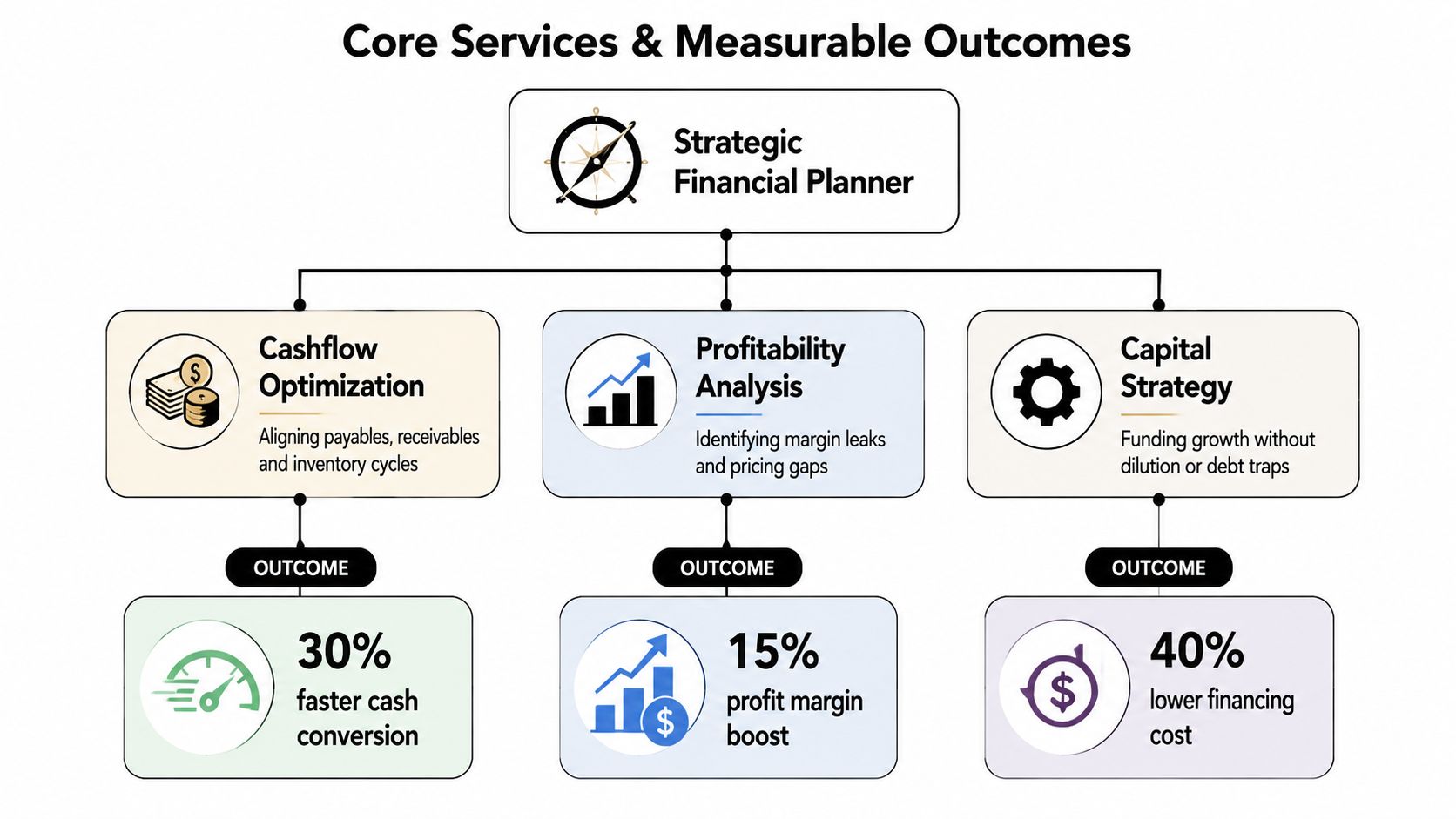
A real strategic financial planner doesn't sell vague reassurance. They build systems around outcomes the owner can feel in the bank account and in the calendar. The work should be visible in forecasts, dashboards, and fewer late-night cash checks.
Cash flow forecasting and recovery
The first job is to produce a decision-grade forecast, not a static budget. FP&A guidance stresses dynamic models, annual planning, and KPI dashboards, because operating data only matters when it drives action (Workday FP&A guide). For an SME, that means mapping timing of receipts, payables, tax, wages, and stock buys so the owner can see stress before it arrives.
Margin analysis and pricing optimisation
If the business is busy but not profitable, pricing is usually wrong or the product mix is. A planner should isolate where margin leaks are hiding, then show which items, clients, or services deserve a price reset. That work is not about guesswork. It's about translating actual performance into pricing discipline.
Inventory and working-capital management
Inventory-heavy businesses win or lose based on stock levels. Too much stock slows cash. Too little stock kills revenue. A strategic financial planner helps owners align purchasing, reorder points, and supplier terms with demand, so cash is not trapped in shelves and containers while payroll is due.
KPI dashboards and systems automation
Australia's financial planning competency guidance includes cash-flow management, budgeting, taxation, monitoring, analytical thinking, and digital thinking as core capabilities (competency guide). That lines up with the technical standard owners should expect. A planner should give you a clean dashboard, not a pile of spreadsheets.
The right deliverables are obvious:
Rolling forecasts that update as trading changes
Scenario models for best case, base case, and stress case
KPI dashboards that surface deviations early
Cash conversion reviews that show where cash is getting stuck
Operational recommendations on pricing, buying, payroll timing, and debt
For a structured view of model design, the three-way forecast approach is the benchmark many owners should expect.
Capital strategy without bad debt
Some businesses need funding, but too many owners borrow reactively. A strategic planner should help decide whether growth needs debt, retained earnings, or a slower rollout. That's the difference between strategic capital use and expensive panic finance.
If you want to know whether a planner is strategic, ask them what changed in the business after their last forecast. If they can't answer in business terms, they're probably just repackaging reporting.
Useful standard: if the planner can't tie their work to cash conversion, margin, or time saved, they're not operating at the level Australian SMEs need.
Real-World Examples from Australian Businesses
An ecommerce founder once told me the business looked healthy, but every stock order felt like a punch in the gut. Sales were coming through, yet cash kept disappearing into inventory that moved too slowly. The planner's first move was blunt. Cut dead stock, tighten buying discipline, and stop ordering from instinct.
Ecommerce with stock trapped on shelves
Before the change, the owner chased revenue and ignored ageing stock. After the change, the business had a clearer view of what was selling, what was sitting, and what was draining cash. That did more than improve liquidity. It gave the founder back time, because buying decisions stopped being a weekly fire drill.
Wholesale distributor with messy debtor timing
A distributor had the opposite problem. The business sold well, but customer payments lagged behind supplier commitments. The planner rebuilt the collections rhythm, reworked debtor visibility, and aligned payment terms with the actual cycle of the business. The result was simpler operations and less owner stress, because the cash picture became predictable enough to manage instead of react to.
Trade services business overloaded by finance admin
A trades operator had no inventory issue, but the owner was spending too much time chasing invoices, approving expenses, and checking whether margins were real. The planner cleaned up reporting, automated repetitive finance tasks, and created a weekly rhythm that showed whether jobs were profitable. That shifted the owner from admin bottleneck to business leader.
For some firms, a virtual CFO platform can sit in this slot, especially when the owner needs forecasting, cash-flow management, performance reporting, and systems support in one place. That's the kind of help that belongs in the operating stack, not in a once-a-year review.
The common thread across all three businesses is visibility. When the owner can see where cash is delayed, which products or jobs are draining margin, and which tasks eat time, decisions get sharper fast. The business stops running on instinct and starts running on numbers that mean something.
Questions to Ask Before Hiring a Strategic Financial Planner
Don't hire on a polished pitch. Hire on proof. If someone says they're strategic, make them show you how they think, what they measure, and where they've changed outcomes in businesses like yours.
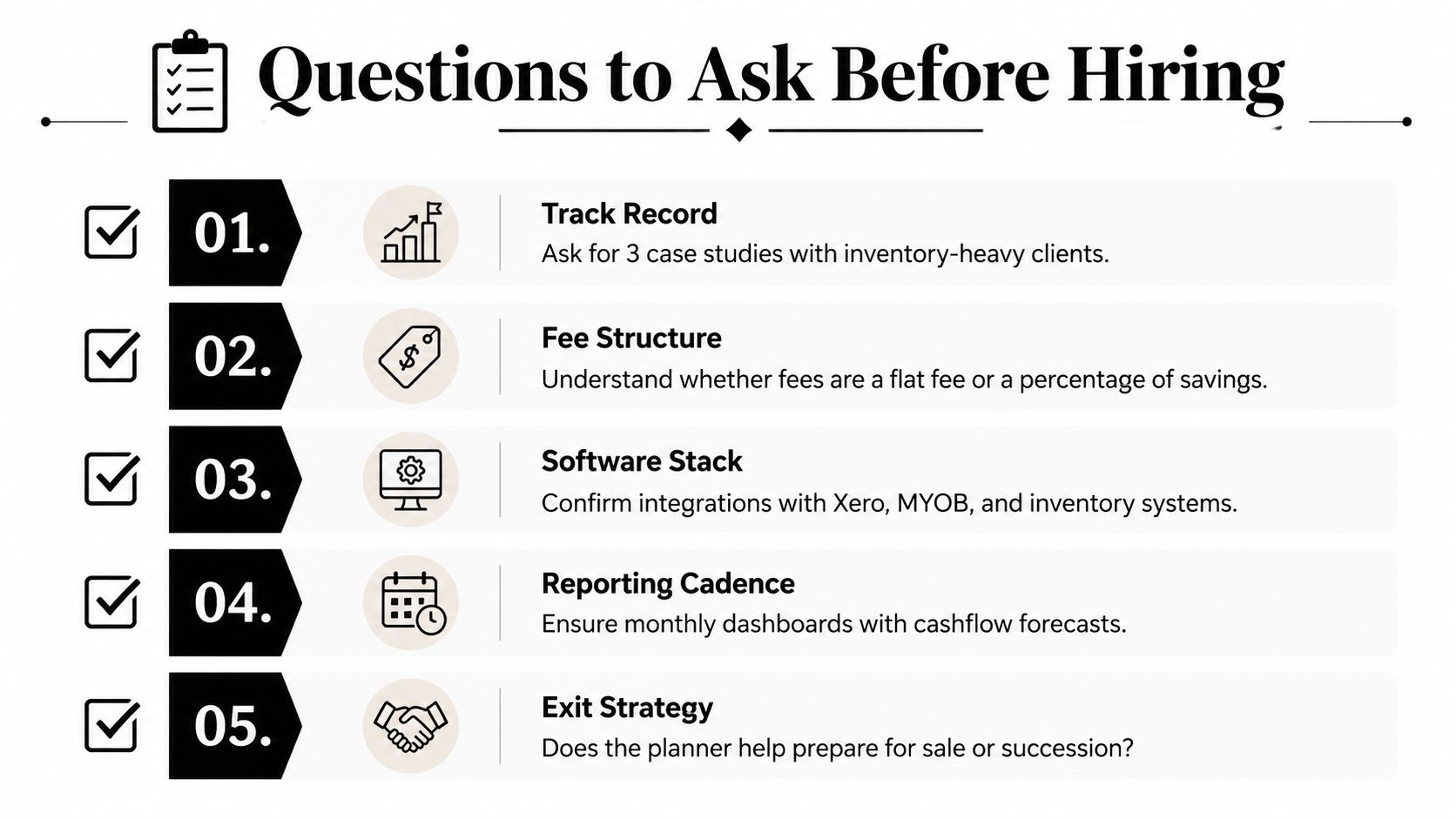
Ask these five questions
Track record: Can you show three examples of working with inventory-heavy or service-based businesses, and what changed after you got involved?
Fee structure: Is your pricing fixed, project-based, or tied to outcomes? Make them explain the trade-offs clearly.
Software stack: How do you connect with Xero, MYOB, inventory tools, and reporting systems without creating more admin?
Reporting cadence: Will I get monthly dashboards and forecast updates, or just occasional commentary?
Exit strategy: Can you help prepare the business for sale, succession, or a leadership handover?
What good answers sound like
You want specifics, not slogans. Good planners can explain how they handle forecasting versus historical reporting, how they work with a founder who hates spreadsheets, and how they fit into an existing team without creating duplication. They should also be able to tell you what success looks like in practical terms.
If their answer stays vague, move on. A planner who can't describe their process will probably not improve yours.
Ask about review rhythm too. A strong engagement isn't a one-off report. It's a cadence that keeps the owner honest about cash, margin, and working capital. That's especially important in businesses where stock, payroll, and debtor timing all move at once.
A final test is simple. Ask what they'd fix first in your business if they started tomorrow. If the answer is specific, practical, and tied to real operating pain, you're probably speaking to the right kind of adviser.
Your Action Plan for Engaging a Strategic Financial Planner
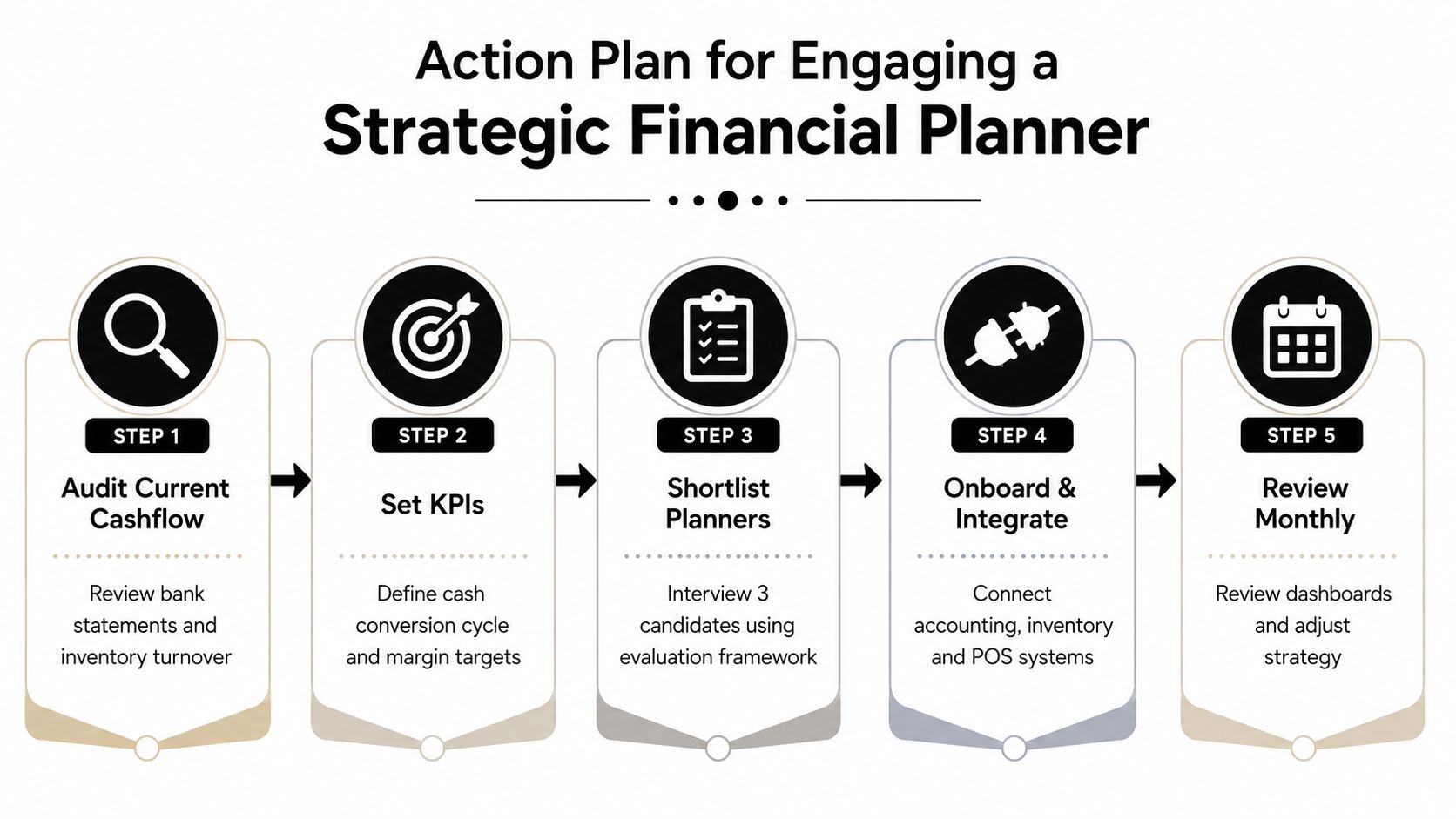
Start with your own numbers. Pull bank statements, debtor ageing, inventory reports, payroll timing, tax obligations, and the last three months of management data into one place. You're looking for where cash gets stuck and where your own time gets burned.
Set the outcome first
Decide what matters most. For some owners, it's tighter cash conversion. For others, it's cleaner margin visibility or fewer hours lost to admin. Don't ask for “better finance.” Ask for a specific business result.
Shortlist with discipline
Speak to three candidates, no more. Use the same questions with each one so you can compare substance, not presentation. If one candidate talks in abstractions and another talks in operating levers, the difference will be obvious.
Build the first 90 days properly
The first month should focus on diagnosis. The second should turn that diagnosis into a forecast, a dashboard, and a small list of operational fixes. By the third month, you should be reviewing decisions, not just outputs.
A good planner won't try to do everything at once. They'll prioritise the cash leaks, the margin leaks, and the time leaks in that order. That sequencing matters because many owners try to optimise too broadly and end up fixing nothing.
Use a simple rule during onboarding. If the engagement doesn't produce clearer decisions, faster visibility, and less owner friction, it's not doing its job. Strategic financial planning should make the business easier to run, not merely easier to report on.
Common Misconceptions About Strategic Financial Planning
“My accountant already does this” is the first objection, and it misses the point. An accountant handles compliance and historical reporting. A strategic financial planner looks at the operating decisions that drive cash, stock, and owner time, then helps fix the parts of the business that are slowing everything down.
“I'm too small for this” is another weak assumption. Small businesses carry the same cash pressure as larger firms, often with less room for error and more day-to-day load on the owner. The right advice at that stage is usually about regaining control of the business, not chasing abstract finance theory.
Then there is the belief that financial planning only belongs in personal wealth discussions. That view is out of date. Survey results show the profession is already focused on long-horizon concerns like retirement funding and sequencing risk (survey results), which is exactly why business owners should expect more than portfolio commentary. They need help with the operating system of the business, not just the investment side of life.
The last objection is cost. Cheap advice that does not improve cash flow is expensive. If a planner helps release trapped cash, sharpen visibility, and reduce the hours the owner spends chasing problems, the fee is judged against real business value, not against a narrow compliance benchmark.
The right question is simple. Can you afford to keep running the business without someone focused on cash conversion, inventory decisions, and owner workload?
strategic financial planner, virtual CFO, cash flow management, SME finance, financial planning Australia

" width="24px"/><g d="M 0 24.129 L 0 0.129 L 24 0.129 L 24 24.129 Z M 0 24.129 L 0 0.129 L 24 0.129 L 24 24.129 Z M 24 3 C 24 1.344 22.656 0 21 0 L 3 0 C 1.344 0 0 1.344 0 3 L 0 21 C 0 22.656 1.344 24 3 24 L 21 24 C 22.656 24 24 22.656 24 21 Z M 6.883 8.375 L 2.863 8.375 L 2.863 20.467 L 6.883 20.467 Z M 4.899 2.545 C 3.524 2.545 2.625 3.449 2.625 4.634 C 2.625 5.795 3.496 6.724 4.846 6.724 L 4.872 6.724 C 6.273 6.724 7.146 5.795 7.146 4.634 C 7.12 3.449 6.274 2.545 4.899 2.545 Z M 16.747 8.09 C 14.614 8.09 13.659 9.263 13.124 10.086 L 13.124 8.374 L 9.105 8.374 C 9.159 9.508 9.105 20.466 9.105 20.466 L 13.124 20.466 L 13.124 13.713 C 13.124 13.352 13.15 12.99 13.257 12.732 C 13.547 12.01 14.209 11.262 15.319 11.262 C 16.773 11.262 17.355 12.372 17.355 13.996 L 17.355 20.466 L 21.374 20.466 L 21.374 13.532 C 21.374 9.818 19.391 8.09 16.747 8.09 Z" fill="transparent" height="24.12890599668026px" id="dSFdkJotL" width="24px"><path d="M 0 24 L 0 0 L 24 0 L 24 24 Z" fill="transparent" height="24px" id="wscNJE44G" transform="translate(0 0.129)" width="24px"/><g d="M 0 24.129 L 0 0.129 L 24 0.129 L 24 24.129 Z M 24 3 C 24 1.344 22.656 0 21 0 L 3 0 C 1.344 0 0 1.344 0 3 L 0 21 C 0 22.656 1.344 24 3 24 L 21 24 C 22.656 24 24 22.656 24 21 Z M 6.883 8.375 L 2.863 8.375 L 2.863 20.467 L 6.883 20.467 Z M 4.899 2.545 C 3.524 2.545 2.625 3.449 2.625 4.634 C 2.625 5.795 3.496 6.724 4.846 6.724 L 4.872 6.724 C 6.273 6.724 7.146 5.795 7.146 4.634 C 7.12 3.449 6.274 2.545 4.899 2.545 Z M 16.747 8.09 C 14.614 8.09 13.659 9.263 13.124 10.086 L 13.124 8.374 L 9.105 8.374 C 9.159 9.508 9.105 20.466 9.105 20.466 L 13.124 20.466 L 13.124 13.713 C 13.124 13.352 13.15 12.99 13.257 12.732 C 13.547 12.01 14.209 11.262 15.319 11.262 C 16.773 11.262 17.355 12.372 17.355 13.996 L 17.355 20.466 L 21.374 20.466 L 21.374 13.532 C 21.374 9.818 19.391 8.09 16.747 8.09 Z" fill="transparent" height="24.12890599668026px" id="sTpjGo1tb" width="24px"><path d="M 0 24 L 0 0 L 24 0 L 24 24 Z" fill="transparent" height="24px" id="s7ffpmKOD" transform="translate(0 0.129)" width="24px"/><g d="M 24 3 C 24 1.344 22.656 0 21 0 L 3 0 C 1.344 0 0 1.344 0 3 L 0 21 C 0 22.656 1.344 24 3 24 L 21 24 C 22.656 24 24 22.656 24 21 Z M 6.883 8.375 L 2.863 8.375 L 2.863 20.467 L 6.883 20.467 Z M 4.899 2.545 C 3.524 2.545 2.625 3.449 2.625 4.634 C 2.625 5.795 3.496 6.724 4.846 6.724 L 4.872 6.724 C 6.273 6.724 7.146 5.795 7.146 4.634 C 7.12 3.449 6.274 2.545 4.899 2.545 Z M 16.747 8.09 C 14.614 8.09 13.659 9.263 13.124 10.086 L 13.124 8.374 L 9.105 8.374 C 9.159 9.508 9.105 20.466 9.105 20.466 L 13.124 20.466 L 13.124 13.713 C 13.124 13.352 13.15 12.99 13.257 12.732 C 13.547 12.01 14.209 11.262 15.319 11.262 C 16.773 11.262 17.355 12.372 17.355 13.996 L 17.355 20.466 L 21.374 20.466 L 21.374 13.532 C 21.374 9.818 19.391 8.09 16.747 8.09 Z" fill="transparent" height="24.000006px" id="D0ecaHEcW" transform="translate(0 0)" width="24px"><path d="M 24 3 C 24 1.344 22.656 0 21 0 L 3 0 C 1.344 0 0 1.344 0 3 L 0 21 C 0 22.656 1.344 24 3 24 L 21 24 C 22.656 24 24 22.656 24 21 Z" fill="rgb(55, 184, 218)" height="24.000006px" id="IPLFE6zXx" width="24px"/><path d="M 4.02 0 L 0 0 L 0 12.092 L 4.02 12.092 Z" fill="rgb(255, 255, 255)" height="12.09201px" id="FWhtzAyuY" transform="translate(2.863 8.375)" width="4.02px"/><path d="M 2.274 0 C 0.899 0 0 0.904 0 2.089 C 0 3.25 0.871 4.179 2.221 4.179 L 2.247 4.179 C 3.648 4.179 4.521 3.25 4.521 2.089 C 4.495 0.904 3.649 0 2.274 0 Z" fill="rgb(255, 255, 255)" height="4.17876px" id="VmOsKv4kO" transform="translate(2.625 2.545)" width="4.52095px"/><path d="M 7.641 0 C 5.509 0 4.554 1.173 4.019 1.996 L 4.019 0.284 L 0 0.284 C 0.053 1.419 0 12.376 0 12.376 L 4.019 12.376 L 4.019 5.623 C 4.019 5.262 4.045 4.9 4.151 4.642 C 4.442 3.92 5.103 3.172 6.214 3.172 C 7.667 3.172 8.25 4.282 8.25 5.907 L 8.25 12.376 L 12.269 12.376 L 12.269 5.442 C 12.269 1.728 10.286 0 7.641 0 Z" fill="rgb(255, 255, 255)" height="12.37626px" id="n1XUbhaq0" transform="translate(9.105 8.09)" width="12.268830000000001px"/></g></g></g></g></svg>)