GST Registration Requirements in Australia
Clear guide to GST registration requirements for Australian SMEs, covering thresholds, exceptions, documents, timelines and a practical checklist.
Ansh Malhotra

Most Australian businesses must register for GST once GST turnover reaches A$75,000, or A$150,000 for not-for-profit organisations, and the ATO gives you 21 days after crossing the line to register. That deadline also applies when your projected turnover shows you're likely to exceed the threshold.
You've just sent your biggest invoice. The client is happy, the pipeline looks strong, and your forecast points towards a A$90,000 year. Then the practical question lands while you're sitting at the kitchen table with a flat white: do you register for GST now, or wait until the numbers make the decision for you?
That decision affects more than compliance. GST registration changes your invoices, pricing, bookkeeping, BAS obligations and cash position. It can also let you claim input tax credits on eligible business purchases, including equipment, software and contractor costs. The mistake is treating registration as an administrative form rather than a decision about how much cash stays in the business.
Table of Contents
The Decision Every Australian Founder Faces
The core GST registration requirements are straightforward. If your GST turnover reaches, or is expected to reach, A$75,000, you must register. The threshold rises to A$150,000 for not-for-profit organisations. The ATO also requires a business that crosses the threshold to register within 21 days, so this isn't something to leave until your next annual tax review. The ATO's GST registration guidance sets out the threshold tests and the registration deadline.
The 21-day period starts when your turnover crosses the relevant line, or when your forecasts show that it's likely to do so. You need to identify the correct effective date, lodge the registration promptly and make sure your invoicing system is ready for the change.
Treat registration as a cash-flow decision
Voluntary registration can make sense before mandatory registration if your business is buying meaningful amounts of taxable business inputs. A new consultancy purchasing laptops and software, or a product business buying stock and packaging, may have GST in its costs that could become input tax credits once the business is registered and the expenses are eligible.
That benefit comes with a trade-off. Once registered, you'll need to charge GST where required, keep suitable records and lodge BAS statements according to your assigned reporting cycle. You'll also need to decide whether your quoted prices are GST-inclusive or whether GST is added separately.
Practical rule: Don't wait for your accountant to discover the threshold after year-end. Review current and projected GST turnover as part of your monthly cash meeting.
Late registration can create a painful pricing problem. If you've quoted a fixed price without allowing for GST, registering later may force you to remit GST from a price your customer already considers final. The business can end up funding the tax from its own margin.
For most small and medium businesses, the decision is binary. Either register because the current or projected test requires it, or maintain organised records that support the conclusion that turnover will remain below the threshold. The ATO's rules also capture businesses that expect to hit the threshold during their first year, so a new venture shouldn't rely only on historic sales.
The A$75,000 Turnover Threshold Explained
The A$75,000 GST threshold is assessed through two rolling tests, not a simple financial-year total. Current GST turnover covers the current month and previous 11 months. Projected GST turnover covers the current month and following 11 months. Both tests can require registration, so a founder must monitor the forward position as closely as past sales.
A consultant earning A$5,000 a month from February illustrates the timing risk. By May, the current and projected turnover pattern may indicate that the business will exceed A$75,000 across the relevant 12-month period. Waiting for year-end is the wrong control. Assess when the threshold is crossed, or expected to be crossed, then act within the 21-day registration window.
Registration timing also affects cash flow. Registering earlier can give an eligible business access to input tax credits on taxable purchases, while delaying the decision can leave GST to be paid from an agreed customer price. Your pricing model, expected BAS obligations and likely input credits should be reviewed together.
Founders with related businesses should also review guidance on aggregated turnover and the ATO. Keep GST turnover separate from total business income. The threshold test does not include every amount deposited into the business bank account.
What belongs in the calculation
GST turnover generally covers supplies made in the ordinary course of business, subject to exclusions. The result can change materially where a business has taxable, input-taxed and agency transactions.
Sale Type | Counted in GST Turnover? | Notes |
|---|---|---|
Ordinary taxable sales | Usually yes | These are the operating sales founders should monitor. |
GST itself | No | GST collected is excluded from turnover. |
Input-taxed sales | No | Input-taxed supplies are excluded. |
Capital asset sales used wholly for input-taxed purposes | No | These sales are excluded under the turnover rules. |
Amounts received as a mere agent | No | Amounts belonging to the principal are not counted in this way. |
The threshold is A$75,000 for most businesses and A$150,000 for not-for-profit organisations. The lower result from the two tests does not control the outcome. Either current or projected GST turnover can trigger registration, even when the previous 12 months appear modest. Review the forecast monthly, especially after signing a large contract or changing prices.
Activity-Based Rules That Override Turnover
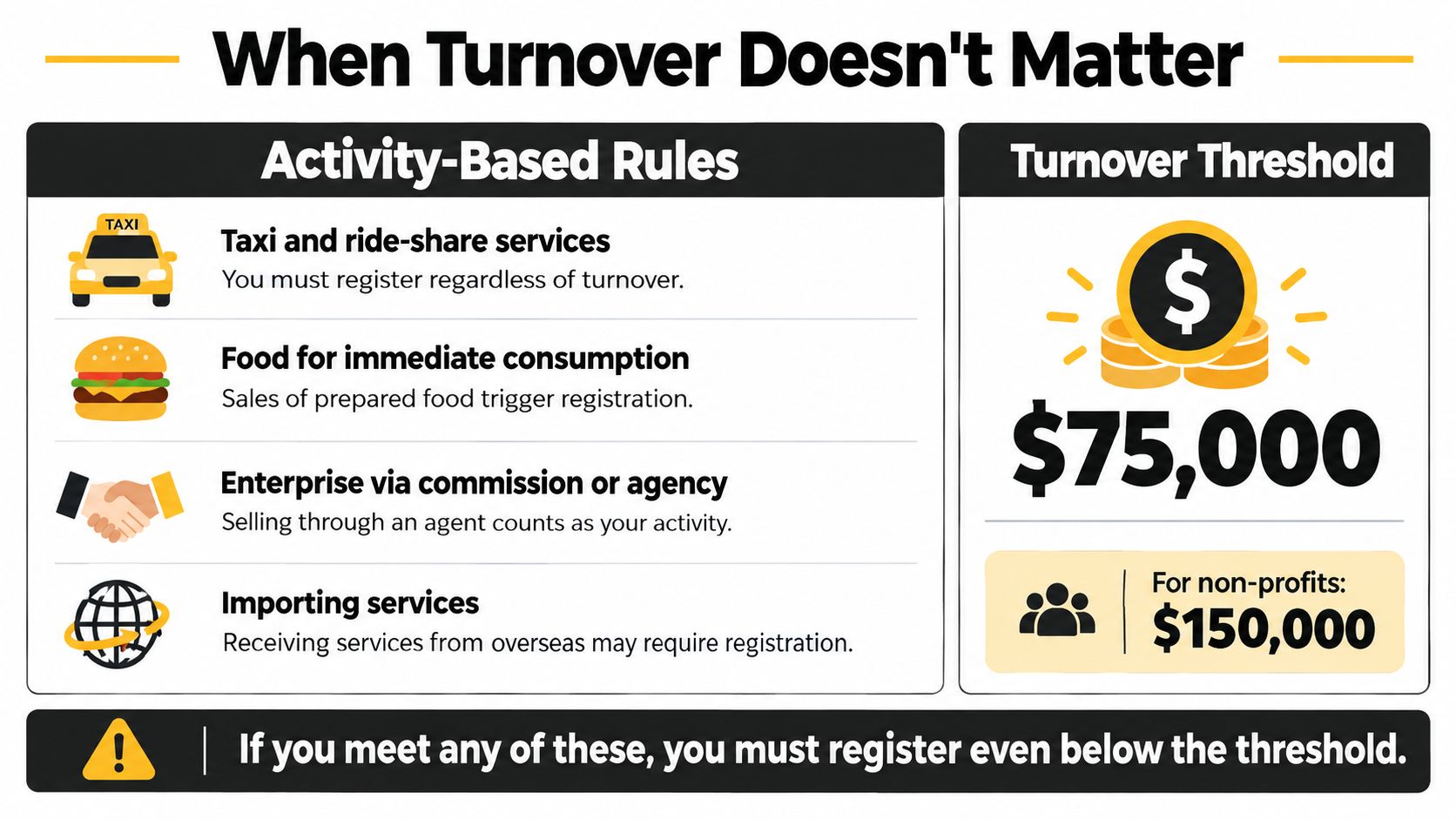
Turnover isn't the only gateway into GST registration. Some activities create a registration obligation regardless of revenue, which means waiting until the business reaches A$75,000 is the wrong approach.
The clearest examples are taxi, limousine and ride-sourcing services. A driver or operator providing those services must register regardless of turnover. The same applies to businesses claiming fuel tax credits, according to business.gov.au's tax registration guidance.
Compare the activity test with the turnover test
Use this decision order:
Taxi, limousine or ride-sourcing operator: Register regardless of turnover. Registration controls should be active before fares begin.
Fuel tax credit claimant: Register regardless of turnover if your business claims those credits.
Business approaching the standard threshold: Apply the current and projected GST turnover tests.
Not-for-profit organisation: Use the higher threshold, while still checking whether an activity-based rule applies.
Other GST rules can affect specific industries and transactions. Sales of new residential property or substantial renovations, and certain activities involving luxury vehicles, may require specialist advice because the GST treatment depends on the transaction and business structure. Don't assume an activity is outside GST because ordinary rent or service revenue is low.
Input-taxed industries create a separate complication. Financial supplies and residential rent, for example, don't work like ordinary taxable sales, and the input-tax treatment can limit what you claim back. A small landlord earning residential rent doesn't automatically need GST registration merely because the rent exceeds A$75,000, because residential rent is input-taxed and excluded from GST turnover.
Documents and Information You Need Before You Start
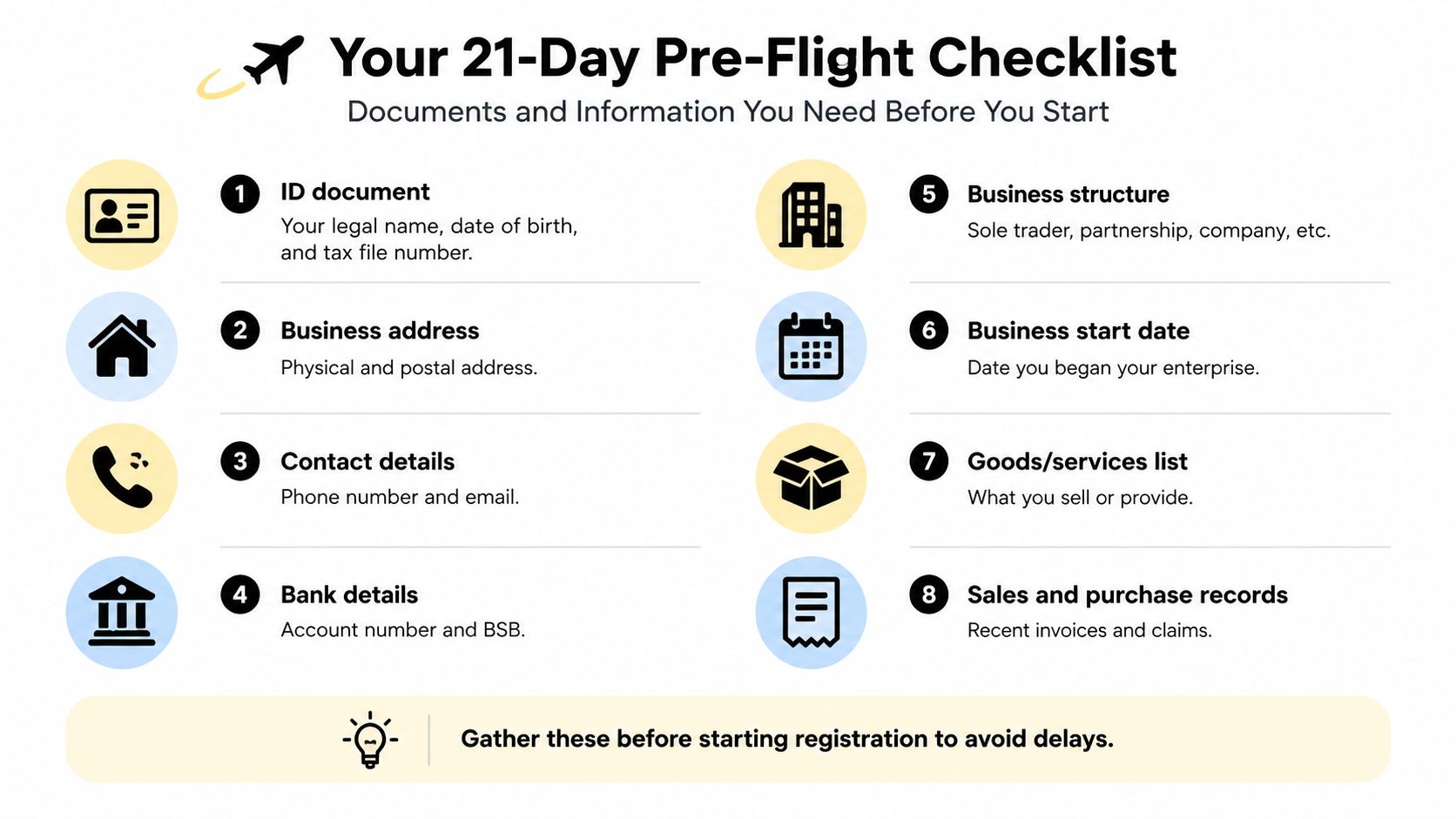
The 21-day window is wasted if you begin the application without the information needed to complete it. Treat registration like a pre-flight check. Gather the details first, then submit once the legal entity, turnover date and business activity all line up.
Prepare the application details
Have these items ready:
ABN status: Confirm the business has an ABN, or note the status of an ABN application.
Entity information: Prepare the legal entity type, trading name and registered business details.
Contact details: Check the registered business address, primary email and contact phone.
Turnover timing: Record when you expect GST turnover to cross the applicable threshold.
Turnover estimate: Prepare a realistic estimate of yearly turnover based on signed work, recurring revenue and credible pipeline.
Business activity: Describe the main activity and identify the relevant ANZSIC code.
Associates: Gather details of associates or related entities where the application requires them.
The application also needs practical supporting material. Keep identity documents such as a driver licence or passport available, along with a partnership or trust deed where relevant, a company registration certificate for a company, and bank account details if the business expects refunds.
Remove the common blockers
Application delays often begin with basic inconsistencies. Check that the identity details used for myGovID match the entity records, that the ABN is active rather than cancelled, and that the selected accounting basis suits how the business tracks sales and purchases.
Don't guess the effective registration date. It affects when you need to charge GST, which sales belong in your BAS records and whether expenses may be eligible for input tax credits. If the date is unclear, resolve it before submitting rather than trying to repair the record later.
Complete submissions are generally processed promptly, but incomplete data creates the friction. A founder who prepares the checklist in one sitting gives the application a much better chance of moving through without avoidable questions.
How to Register and What Happens Next
Start through the ATO's online business registration process using the business's authorised access arrangements and myGovID. Confirm the entity details, select GST registration, enter the expected turnover information, choose the effective date and provide the reporting information requested by the portal.
The important decision isn't just clicking submit. Your BAS reporting cycle affects how quickly GST collected moves out of the business bank account and how often your team must reconcile transactions.
Choose the cycle that fits the cash pattern
Cycle | Eligibility | Cash-Flow Impact | Best Fit |
|---|---|---|---|
Monthly | Available where the business is required or chooses monthly reporting | More frequent reconciliation and remittance | Businesses that want close control of GST cash movements |
Quarterly | Common for smaller businesses under the relevant ATO settings | Aligns GST review with a regular quarterly rhythm | Most growing SMEs using an accountant or BAS agent |
Annually | Restricted to eligible smaller businesses and certain not-for-profits | Delays the regular GST remittance cycle but creates a larger catch-up task | Businesses with simple records and stable activity |
The ATO's exact reporting treatment depends on the business's circumstances and turnover. Don't choose annual reporting because it reduces immediate administration. If your sales are seasonal or your purchases are large, quarterly or monthly reporting may give you better visibility of what cash is available.
Founders setting up a new entity can use a specialist resource on how to set up an Australian company, but company formation and GST registration are separate decisions. Forming a company doesn't automatically complete the GST application.
After submission, keep the confirmation and note the effective GST registration date. Update invoice templates, point-of-sale settings and accounting software before the first taxable sale after that date. Your first BAS will require clean sales, purchase and GST coding, so don't postpone the bookkeeping setup until the lodgement deadline is close.
Two Founder Scenarios Walked Through
A freight operator and an ecommerce founder can face the same GST threshold but experience very different cash consequences.
Scenario one, the freight operator
A sole-trader freight operator runs one truck and sees the annualised business turnover move above A$75,000 during the third quarter. The projected turnover test is enough to create the registration obligation. The operator has 21 days to lodge the registration, then needs to revise the quote sheet and customer invoices.
The commercial question is margin. If the operator has been quoting prices as final, adding GST on top may be difficult with existing customers. If the price stays unchanged, the GST component comes out of the quoted amount. The operator should rebuild rates using the business's actual costs, including fuel, tyres, repairs and subcontracted work, then decide whether the market will accept a GST-exclusive price plus GST or a GST-inclusive price.
Eligible business purchases can create input tax credits, but the operator needs valid tax invoices and accurate records. Fuel, tyres and repairs shouldn't be treated as automatic credits without checking the GST treatment and retaining the required evidence.
Scenario two, the ecommerce brand
An ecommerce brand sells below the threshold through a local Shopify store, then signs wholesale orders that change the projected 12-month position. The current sales history looks safe, but the forward test says otherwise. Registration becomes a planning issue before the next wholesale invoice is raised.
The founder now needs to review product pricing, Shopify settings, payment fees and inventory records. GST may affect the way the brand presents prices to consumers and the way it reconciles platform charges. Stock already held may require careful review if the founder considers voluntary or backdated registration, because eligibility depends on the registration date, the nature of the purchase and the supporting records.
Both founders should reserve GST collected rather than treating it as operating revenue. The first BAS is the point where the bookkeeping system proves whether the registration decision was managed properly. A clean reconciliation can protect working capital. A rushed one can expose missing invoices, incorrect tax codes and a cash shortfall.
Ongoing Reporting and Compliance Obligations
Registration changes the rhythm of the finance function. You'll need to collect GST where required, preserve evidence for claims, reconcile the GST control accounts and lodge BAS statements on time. The business's reporting cycle determines how often those tasks happen, while the ATO's rules and the entity's circumstances determine which cycle applies.
Keep the records that support sales, purchases, adjustments and input tax credit claims. Store invoices, receipts, contracts and payment evidence in a system your accountant or BAS agent can access without reconstructing transactions from bank statements.
Build compliance into the cash routine
A monthly close should answer three questions:
What GST did we collect? Reconcile sales invoices, payment platforms and bank receipts.
What GST did we pay? Match purchase records to valid tax invoices and review unusual expenses.
What cash must we reserve? Separate the expected BAS liability from funds available for wages, stock or growth spending.
The ATO may pay attention to late lodgements, inconsistent BAS figures, unsupported credit claims and differences between accounting records and reported activity. Those aren't reasons to avoid registration. They're reasons to maintain a disciplined close process.
For a wider view of the tax systems that sit around GST, review this small business taxation guide. It helps place GST inside the broader obligations of a growing business rather than treating it as an isolated form.
Cycle | Lodgement Deadline | Typical Assignment | Cash-Flow Impact |
|---|---|---|---|
Monthly | Set by the ATO for the relevant monthly period | Businesses needing or choosing frequent reporting | Faster visibility, more regular administration |
Quarterly | Set by the ATO for the relevant quarter | Common for many smaller businesses | Regular forecasting without monthly processing |
Annually | Set by the ATO for eligible annual reporters | Certain smaller businesses and not-for-profits | Less frequent lodgement, but greater risk of a large unplanned liability |
Don't confuse an adjustment note with a simple credit note. The document must support the underlying GST adjustment and link clearly to the original transaction. Your bookkeeping software, whether Xero, MYOB or QuickBooks, should use separate tax codes for taxable, GST-free and input-taxed transactions.
Your Practical GST Registration Checklist
Start with one decision. Is your GST turnover at or expected to reach A$75,000, or A$150,000 if you're a not-for-profit? If not, do you provide taxi, limousine or ride-sourcing services, or claim fuel tax credits? If the answer to either question is yes, treat registration as an immediate task and work inside the 21-day deadline.

Use this sequence:
Confirm the trigger: Check current and projected GST turnover, then document the date that creates the obligation.
Gather the file: Prepare ABN details, entity information, identity documents, bank details, business activity and related-entity information.
Submit online: Complete the ATO registration process and record the effective GST date.
Choose deliberately: Select a BAS cycle that matches your cash-flow volatility and bookkeeping capacity.
Fix the systems: Update Xero, MYOB or QuickBooks tax codes, invoice templates, Shopify or point-of-sale settings and payment workflows.
Protect the cash: Move GST collected into a separate reserve and reconcile purchases before claiming credits.
Calendar the first BAS: Give your accountant or BAS agent the records early, not on the due date.
You can also use this SME compliance checklist to turn the registration tasks into a repeatable finance process. Create your own downloadable PDF checklist from the sequence above and keep it with your monthly close documents.
Log into the ATO portal today and test whether projected turnover is likely to cross the threshold during the next quarter. If voluntary registration suits your cash position, assess setup costs and eligible input tax credits before you make the call.
Nexist helps Australian founders connect GST registration with pricing, BAS preparation and cash-flow control, including bookkeeping, invoicing, forecasting and virtual CFO support. Visit Nexist to discuss the registration decision and build a finance process that keeps GST from becoming an unexpected drain on working capital.
gst registration, australian small business, tax compliance, ato gst thresholds, smg accounting checklist

" width="24px"/><g d="M 0 24.129 L 0 0.129 L 24 0.129 L 24 24.129 Z M 0 24.129 L 0 0.129 L 24 0.129 L 24 24.129 Z M 24 3 C 24 1.344 22.656 0 21 0 L 3 0 C 1.344 0 0 1.344 0 3 L 0 21 C 0 22.656 1.344 24 3 24 L 21 24 C 22.656 24 24 22.656 24 21 Z M 6.883 8.375 L 2.863 8.375 L 2.863 20.467 L 6.883 20.467 Z M 4.899 2.545 C 3.524 2.545 2.625 3.449 2.625 4.634 C 2.625 5.795 3.496 6.724 4.846 6.724 L 4.872 6.724 C 6.273 6.724 7.146 5.795 7.146 4.634 C 7.12 3.449 6.274 2.545 4.899 2.545 Z M 16.747 8.09 C 14.614 8.09 13.659 9.263 13.124 10.086 L 13.124 8.374 L 9.105 8.374 C 9.159 9.508 9.105 20.466 9.105 20.466 L 13.124 20.466 L 13.124 13.713 C 13.124 13.352 13.15 12.99 13.257 12.732 C 13.547 12.01 14.209 11.262 15.319 11.262 C 16.773 11.262 17.355 12.372 17.355 13.996 L 17.355 20.466 L 21.374 20.466 L 21.374 13.532 C 21.374 9.818 19.391 8.09 16.747 8.09 Z" fill="transparent" height="24.12890599668026px" id="dSFdkJotL" width="24px"><path d="M 0 24 L 0 0 L 24 0 L 24 24 Z" fill="transparent" height="24px" id="wscNJE44G" transform="translate(0 0.129)" width="24px"/><g d="M 0 24.129 L 0 0.129 L 24 0.129 L 24 24.129 Z M 24 3 C 24 1.344 22.656 0 21 0 L 3 0 C 1.344 0 0 1.344 0 3 L 0 21 C 0 22.656 1.344 24 3 24 L 21 24 C 22.656 24 24 22.656 24 21 Z M 6.883 8.375 L 2.863 8.375 L 2.863 20.467 L 6.883 20.467 Z M 4.899 2.545 C 3.524 2.545 2.625 3.449 2.625 4.634 C 2.625 5.795 3.496 6.724 4.846 6.724 L 4.872 6.724 C 6.273 6.724 7.146 5.795 7.146 4.634 C 7.12 3.449 6.274 2.545 4.899 2.545 Z M 16.747 8.09 C 14.614 8.09 13.659 9.263 13.124 10.086 L 13.124 8.374 L 9.105 8.374 C 9.159 9.508 9.105 20.466 9.105 20.466 L 13.124 20.466 L 13.124 13.713 C 13.124 13.352 13.15 12.99 13.257 12.732 C 13.547 12.01 14.209 11.262 15.319 11.262 C 16.773 11.262 17.355 12.372 17.355 13.996 L 17.355 20.466 L 21.374 20.466 L 21.374 13.532 C 21.374 9.818 19.391 8.09 16.747 8.09 Z" fill="transparent" height="24.12890599668026px" id="sTpjGo1tb" width="24px"><path d="M 0 24 L 0 0 L 24 0 L 24 24 Z" fill="transparent" height="24px" id="s7ffpmKOD" transform="translate(0 0.129)" width="24px"/><g d="M 24 3 C 24 1.344 22.656 0 21 0 L 3 0 C 1.344 0 0 1.344 0 3 L 0 21 C 0 22.656 1.344 24 3 24 L 21 24 C 22.656 24 24 22.656 24 21 Z M 6.883 8.375 L 2.863 8.375 L 2.863 20.467 L 6.883 20.467 Z M 4.899 2.545 C 3.524 2.545 2.625 3.449 2.625 4.634 C 2.625 5.795 3.496 6.724 4.846 6.724 L 4.872 6.724 C 6.273 6.724 7.146 5.795 7.146 4.634 C 7.12 3.449 6.274 2.545 4.899 2.545 Z M 16.747 8.09 C 14.614 8.09 13.659 9.263 13.124 10.086 L 13.124 8.374 L 9.105 8.374 C 9.159 9.508 9.105 20.466 9.105 20.466 L 13.124 20.466 L 13.124 13.713 C 13.124 13.352 13.15 12.99 13.257 12.732 C 13.547 12.01 14.209 11.262 15.319 11.262 C 16.773 11.262 17.355 12.372 17.355 13.996 L 17.355 20.466 L 21.374 20.466 L 21.374 13.532 C 21.374 9.818 19.391 8.09 16.747 8.09 Z" fill="transparent" height="24.000006px" id="D0ecaHEcW" transform="translate(0 0)" width="24px"><path d="M 24 3 C 24 1.344 22.656 0 21 0 L 3 0 C 1.344 0 0 1.344 0 3 L 0 21 C 0 22.656 1.344 24 3 24 L 21 24 C 22.656 24 24 22.656 24 21 Z" fill="rgb(55, 184, 218)" height="24.000006px" id="IPLFE6zXx" width="24px"/><path d="M 4.02 0 L 0 0 L 0 12.092 L 4.02 12.092 Z" fill="rgb(255, 255, 255)" height="12.09201px" id="FWhtzAyuY" transform="translate(2.863 8.375)" width="4.02px"/><path d="M 2.274 0 C 0.899 0 0 0.904 0 2.089 C 0 3.25 0.871 4.179 2.221 4.179 L 2.247 4.179 C 3.648 4.179 4.521 3.25 4.521 2.089 C 4.495 0.904 3.649 0 2.274 0 Z" fill="rgb(255, 255, 255)" height="4.17876px" id="VmOsKv4kO" transform="translate(2.625 2.545)" width="4.52095px"/><path d="M 7.641 0 C 5.509 0 4.554 1.173 4.019 1.996 L 4.019 0.284 L 0 0.284 C 0.053 1.419 0 12.376 0 12.376 L 4.019 12.376 L 4.019 5.623 C 4.019 5.262 4.045 4.9 4.151 4.642 C 4.442 3.92 5.103 3.172 6.214 3.172 C 7.667 3.172 8.25 4.282 8.25 5.907 L 8.25 12.376 L 12.269 12.376 L 12.269 5.442 C 12.269 1.728 10.286 0 7.641 0 Z" fill="rgb(255, 255, 255)" height="12.37626px" id="n1XUbhaq0" transform="translate(9.105 8.09)" width="12.268830000000001px"/></g></g></g></g></svg>)