
Bank Reconciliation Process: Australian SME Guide 2026
Understand the bank reconciliation process for Australian SMEs. Learn to match transactions, catch errors, and keep your finances accurate in 2026.
Ansh Malhotra

80% of Australian SMEs still rely on manual or partial bank reconciliation, and 38% identify manual data-entry errors as their biggest headache, according to OFX's 2025 Australian SME financial-management study. That isn't a bookkeeping inconvenience. It's a control failure that can hide incorrect GST coding, duplicate payments, stale receivables, stock-related cash pressure and a bank balance your team can't trust.
A sound bank reconciliation process compares bank activity with the accounting ledger, explains every difference and preserves evidence for review. A weak one clicks “reconcile” until the software accepts an opening balance. The first approach gives a founder usable cash intelligence. The second creates tidy-looking books with unresolved risk underneath.
Australian SMEs should move away from a slow, end-of-month matching ritual and towards an exception-led workflow. Bank feeds and automation should clear routine transactions, while people investigate mismatches, timing differences, opening balances and tax treatment. Convenience matters, but control matters more.
Table of Contents
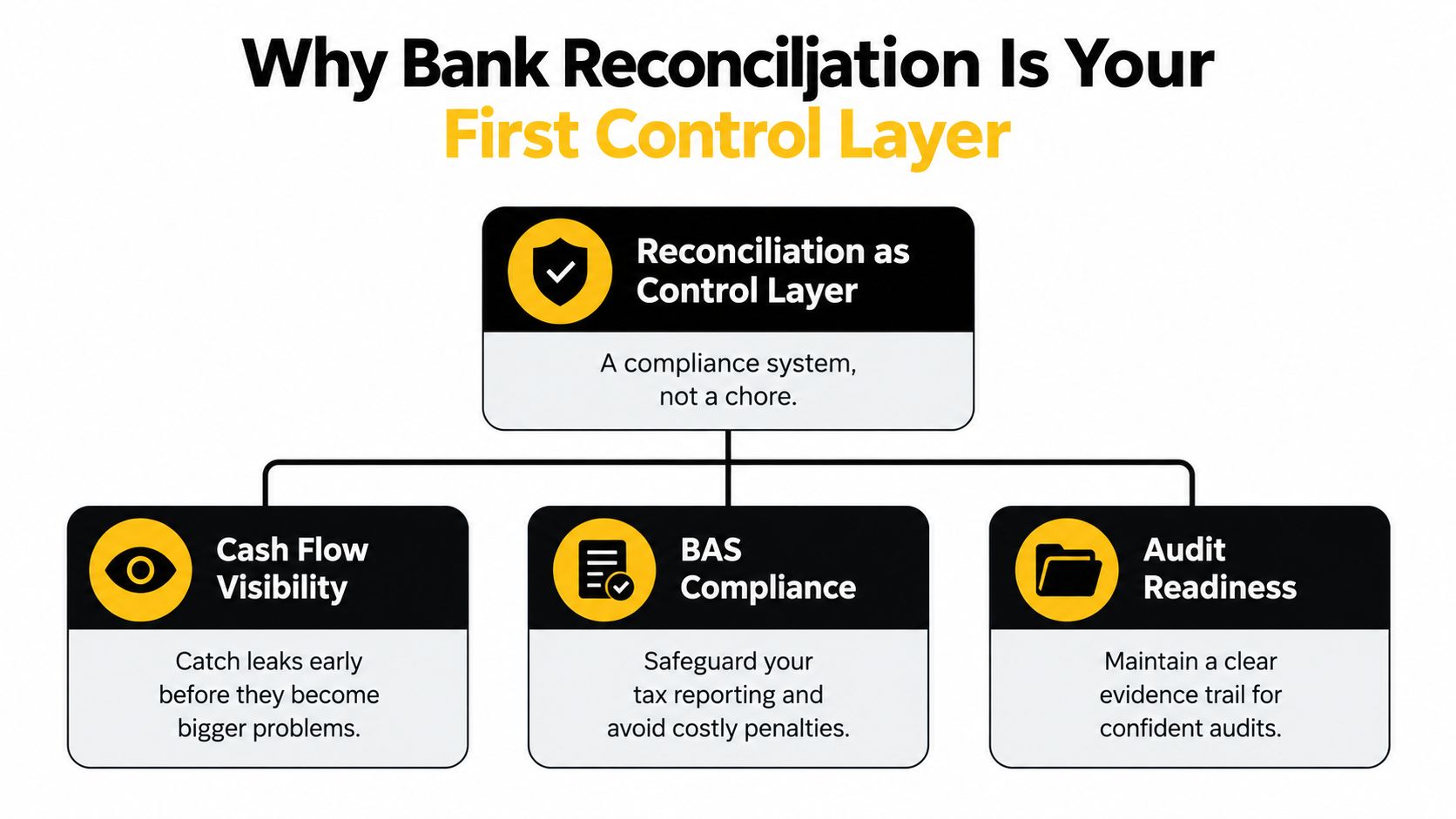
Why Bank Reconciliation Is Your First Control Layer
The Australian Taxation Office requires businesses to keep banking records for 5 years, starting from when the records were prepared or obtained, or when the related transaction occurred, whichever is later, as outlined in this Australian guide to bank reconciliation and record keeping. That retention period changes the job completely. A reconciliation isn't just a month-end admin task. It creates part of the evidence trail supporting BAS reporting, income tax work and future audit questions.
If a payment made today is still unexplained years later, the problem won't be solved by remembering what happened. The business needs a bank record, ledger entry, supporting document and clear reconciliation history. Regular matching makes that evidence easier to assemble while the transaction is still familiar.
Cash visibility starts with explained differences
A bank balance can look healthy while cash is already committed. Uncleared deposits may inflate the ledger. Outstanding payments may make available cash look stronger than it is. Bank fees may sit outside the books altogether. Each item creates a different view of reality for the founder, bookkeeper and bank.
The control question isn't “does the balance look close?” It's “can we explain why the two records differ, and do we know when that difference will clear?” A reconciled account answers both questions.
Practical rule: Never treat an unexplained difference as harmless because it's small. Repeated small errors often reveal a broken process, not an isolated mistake.
Compliance depends on classification, not just matching
Matching a transaction to a ledger line doesn't prove the transaction has the right account or GST code. A bank fee might be imported and matched successfully, yet still be classified incorrectly for BAS purposes. The reconciliation process must therefore test amount, date, account, GST treatment and supporting evidence.
That is why reconciled records matter over the full retention window. They show not only that money moved, but also how the business recorded and explained the movement. A control that checks only the amount is incomplete.
The operational recommendation is straightforward: reconcile accounts on a consistent cadence, resolve exceptions before period close and retain the evidence behind every adjustment. This turns reconciliation into the first layer protecting cash visibility, BAS accuracy and audit readiness.
Running a Weekly or Monthly Reconciliation Routine
Start with the correct data window. Australian accounting software guidance says reconciliation is typically tied to monthly bank statements, while modern bank feeds can import historical data for up to 12 months for most Australian banks and up to 2 years for some institutions, according to this Australian explanation of bank reconciliation. That window is useful after a software migration, a new entity setup or a bookkeeping correction, but it isn't a substitute for maintaining reconciliations as you go.
Before matching anything, confirm the bank account, statement dates and opening balance. If the opening balance is wrong, every later match can appear correct while the account remains fundamentally misstated.
Prepare the feed, then match with intent
Use the feed to bring in bank activity, but don't accept every suggested match automatically. Compare the transaction date, amount, payee, reference and account code. A recurring supplier payment may be safe to match through a rule, while an unfamiliar transfer deserves human review.
Work through deposits and withdrawals separately. Confirm customer receipts against invoices or receipts, then check supplier payments against bills and approval records. Review card settlements, payroll payments, loan movements and transfers between business accounts because these often create timing or duplication issues.
Clear timing differences without hiding them
A legitimate timing difference needs a clear explanation and an owner. An uncleared deposit should remain visible until the bank processes it. An outstanding payment should be tracked rather than deleted or forced through the reconciliation just to reach zero.
Bank fees, interest and other bank-originated transactions require ledger entries and GST review before close. Don't let the bank feed decide tax treatment without a documented rule or a person checking exceptions.
The period should close only after the account agrees, or after every remaining difference has been documented, supported and assigned for resolution. A forced reconciliation is not a completed control. It's an unresolved problem moved into the next period.
Use a short close checklist
Confirm the opening balance: Tie it to the prior signed-off reconciliation.
Check the feed range: Make sure no statement days or duplicate imports are missing.
Review unmatched deposits: Trace receipts to customers, invoices or other source records.
Review unmatched payments: Check suppliers, payroll, cards, taxes and transfers.
Code bank fees carefully: Verify the account and GST treatment before posting.
Investigate duplicates: Compare similar dates, amounts, references and payees.
Age outstanding items: Escalate differences that remain open instead of carrying them indefinitely.
Document sign-off: Keep the preparer, reviewer, date, adjustments and supporting evidence.
For low-volume accounts, monthly reconciliation may align with the statement and close cycle. For volatile or inventory-heavy businesses, a weekly review gives the owner earlier warning about payment timing, stock purchases and collection gaps. The right cadence is the one that keeps exceptions small enough to investigate properly.
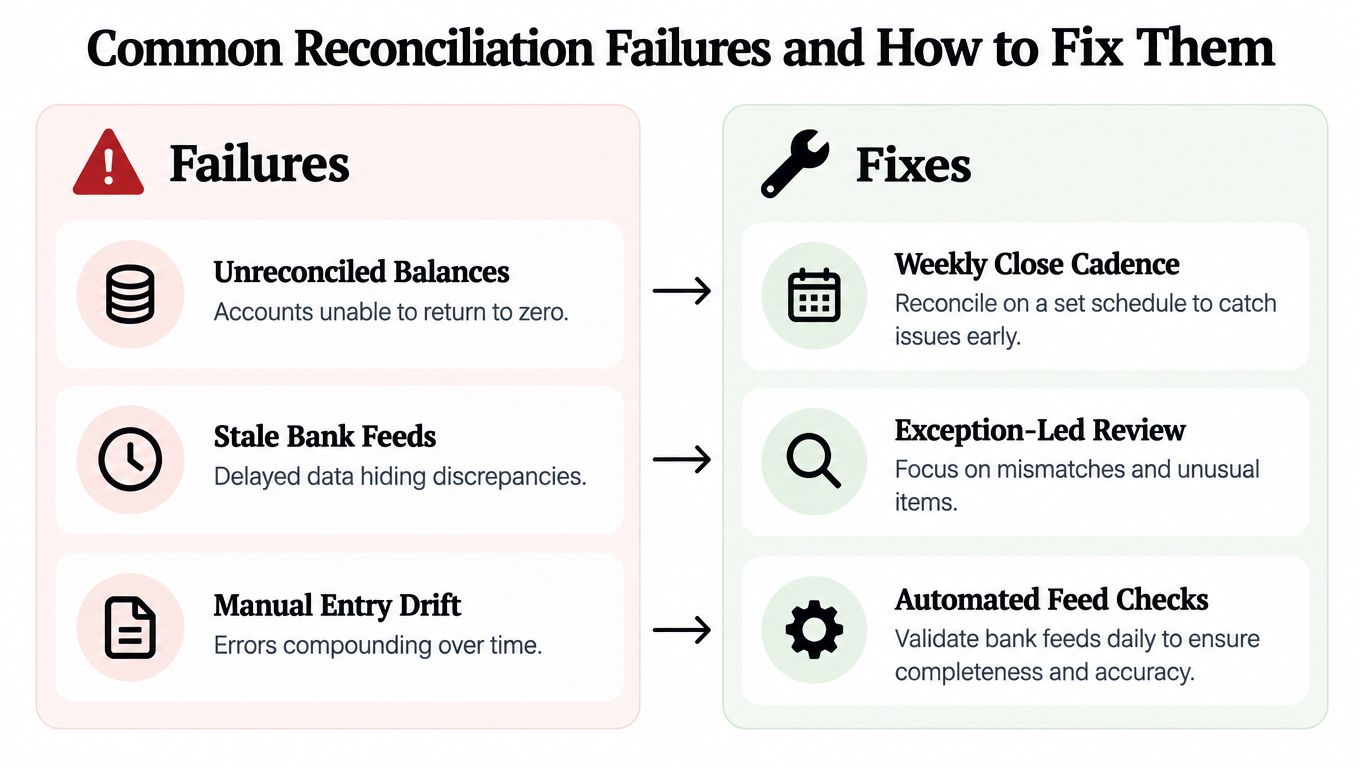
Common Reconciliation Failures and How to Fix Them
Public-sector audit evidence in Australia found that reconciliations were not always performed or performed correctly, and some operating accounts couldn't be brought back to zero or agreed to the general ledger or cash book, as documented in this audit report on bank account reconciliations. The lesson applies to SMEs: an account that doesn't reconcile isn't cosmetically untidy. It signals that the records don't yet prove completeness and accuracy.
A non-zero difference usually points to one of four conditions:
Timing lag: The ledger and bank processed the transaction in different periods.
Misposting: The amount is recorded, but in the wrong account or with incorrect GST treatment.
Duplicate entry: The same bank activity entered more than once.
Omitted transaction: The bank processed an item that never reached the ledger.
Compare the failure with the control
Failure | What it creates | Required control |
|---|---|---|
Unreconciled balance | Unreliable cash reporting and weak audit evidence | Investigate the difference and retain support before close |
Stale bank feed | Delayed visibility of payments, fees and receipts | Monitor feed status and confirm the statement range |
Manual entry drift | Repeated keying errors and inconsistent coding | Use feeds, rules and exception review |
Incorrect GST coding | BAS corrections and unreliable tax reporting | Review tax treatment for bank-originated transactions |
Forced reconciliation | A zero balance without a proven explanation | Prohibit write-offs or forced closes without approval |
Bank fees deserve special attention. Australian expert guidance identifies bank fees and similar items as a common GST-coding trap. A transaction can be matched perfectly and still damage the BAS if the classification is wrong. Require the person reviewing the reconciliation to check the code, not just the match status.
Make evidence part of the close
Every unresolved item should have a reason, source document, owner and next action. Keep matched pairs, account and GST codes, overrides, adjustments and final sign-off. That record helps a reviewer distinguish a genuine timing item from a concealed posting error.
Duplicate charges are another practical exception. When a business suspects a supplier or card duplicate, this resource on how Compass+ solves duplicate charges provides a useful investigation reference. The accounting team should still verify the underlying bank line, supplier record and approval trail before reversing anything.
The best fix isn't “reconcile harder” at month end. It's a control that prevents unresolved exceptions from surviving into the next period. Set a clear escalation path, review repeat errors and make the process owner accountable for the quality of the close.
Automating Bank Feeds in Xero and QuickBooks
Automation should remove repetitive matching, not remove judgement. Xero and QuickBooks can import bank activity, suggest matches and apply rules to recurring transactions. That works well for predictable items, but it won't reliably resolve an incorrect opening balance, a partial payment, a duplicate import or a transaction posted to the wrong GST category.
Australian commentary describes a move towards exception-led reconciliation. One Australian overview of bank reconciliation automation says 60%+ of SMEs spend over two days a month on reconciliation, while AI and bank-feed tools can reduce a typical cycle from 30–60 minutes to under 10 minutes or to a short exception review. Those figures don't mean every business should automate blindly. They show where routine matching can be removed so people can focus on risk.

Configure automation around risk
Start with clean account mappings, reliable supplier names and clear rules for recurring activity. Review what the system auto-matches and create an exception queue for anything that falls outside the expected pattern.
Human review is mandatory when:
The opening balance changes: Rebuild the prior reconciliation before continuing.
The amount differs: Check for partial payments, fees, refunds or split transactions.
The transaction is unusual: Investigate unfamiliar payees, transfers and large movements.
The GST code is uncertain: Check the supporting document and tax treatment.
Inventory is involved: Match supplier payments to purchase records and stock movement.
The system suggests a forced match: Reject convenience if the evidence isn't complete.
The goal is not a permanently hands-off ledger. The goal is a system where routine items clear quickly and exceptions reach the right person with enough context to decide.
Connect feeds to the wider workflow
Bank feeds won't repair slow approvals, incomplete purchase records or poor receivables discipline. If a customer pays without a usable reference, the reconciliation team still has to identify the receipt. If stock is bought outside the purchasing workflow, the bank line won't explain what inventory entered the business.
Review the wider automating business processes workflow before adding more rules. The same principle applies to payment operations. For ecommerce teams, payment-system architecture and settlement flows are explained for growing brands, particularly where platform payouts and processor fees need to tie back to accounting records.
Automation is enough when the transaction is routine, the rule is tested and the evidence is complete. It isn't enough when the item changes cash forecasting, stock valuation, BAS treatment or fraud exposure.
Using Reconciliation as a Cash-Flow Control System
A reconciled ledger tells you where cash went. A useful finance system tells you why cash moved and what that movement means for the next decision.
The OFX study found that 80% of Australian SMEs rely on manual or partial reconciliation and 38% identify manual data-entry errors as their biggest headache, as reported in its 2025 Australian SME financial-management study. That points to a workflow problem, not just a matching problem. If approvals, inventory receipts, invoices and payments don't connect, the reconciliation team becomes the final repair shop for every upstream failure.
Read exceptions as operating signals
A recurring unmatched supplier payment may indicate poor purchase-order discipline. A growing group of customer receipts without invoice references may indicate weak collections administration. Repeated bank fees can expose an unsuitable account structure or payment process.
Inventory businesses should compare reconciled cash movements with purchase timing and stock commitments. Cash can leave the bank well before stock converts into sales. If the reconciliation shows large supplier outflows while receivables remain slow, the founder needs a working-capital decision, not a prettier spreadsheet.
Use a compact management view:
Measure | What it tells you |
|---|---|
Reconciliation cycle time | Whether the workflow is becoming easier or more fragile |
Age of unmatched items | Whether exceptions are being resolved or carried forward |
Repeated coding corrections | Whether rules and training are failing |
BAS error incidence | Whether transaction classification is creating tax risk |
Unexplained cash movements | Whether approvals, payments or records are incomplete |
These measures don't replace financial statements. They show whether the control environment is healthy enough for the statements to be trusted.
Give receivables a place in the review
A receipt that can't be allocated is cash received but not yet connected to the customer ledger. That weakens collection reporting and can make overdue invoices harder to identify. Use the reconciliation queue to prompt action, then strengthen the process through disciplined accounts receivable management.
The virtual CFO's role is to turn those patterns into decisions. That may mean changing payment approvals, tightening supplier terms, adjusting stock purchasing or prioritising collections before authorising another outflow. Reconciliation becomes valuable when the founder uses it to change behaviour, not merely certify that the books are complete.
Next Steps for Scaling with a Virtual CFO
A clean reconciliation gives a growing business a dependable base for forecasting, debt decisions, KPI reporting and process design. It doesn't produce those outcomes automatically. The finance lead still needs to connect reconciled cash data with sales, margins, inventory, payroll, tax obligations and the payment calendar.
Start by separating work that software can perform from work that requires judgement.
Automate routine matching: Use bank feeds and tested rules for predictable transactions.
Assign exception ownership: Give each unresolved item a person, reason and due date.
Review tax treatment: Check GST codes on bank-originated transactions and unusual expenses.
Protect opening balances: Investigate prior-period differences before changing current records.
Report cash by decision: Show available cash, committed payments, expected receipts and stock funding needs.
Document the close: Retain the reconciliation, evidence, adjustments and approval trail.
A virtual CFO should challenge the process, not merely receive the final report. That means asking why the same mismatch keeps appearing, why suppliers are paid before stock turns, why customer receipts remain unallocated or why the forecast repeatedly misses payment timing.
Some founders need process ownership before they need higher-level planning. A remote bookkeeper can help maintain transaction processing and reconciliations, while a finance adviser designs controls, reviews exceptions and turns the resulting data into decisions. The responsibilities should remain clear. The person entering transactions shouldn't be the only person approving the reconciliation.
Use virtual CFO services when the business needs more than clean records. The right support connects reconciliation to rolling cash-flow forecasts, margin targets, inventory planning, debt management, KPI reviews and automation priorities.
Your quick-start plan is simple. Reconcile the highest-risk bank account first, correct the opening balance, clear or assign every exception, review recurring GST errors and set a cadence that matches transaction volume and cash pressure. Then use the results in a weekly cash meeting, where the founder decides what to collect, defer, fund or stop.
Nexist helps Australian founders turn bank reconciliation into a practical cash-flow control, with bookkeeping, BAS support, automation, forecasting and virtual CFO guidance connected to the decisions behind the numbers. Visit Nexist to discuss your reconciliation gaps and build a finance workflow that gives you clearer cash, stronger controls and more time to lead the business.
bank reconciliation process, Australian SME accounting, Xero bank feeds, QuickBooks automation, virtual CFO services

" width="24px"/><g d="M 0 24.129 L 0 0.129 L 24 0.129 L 24 24.129 Z M 0 24.129 L 0 0.129 L 24 0.129 L 24 24.129 Z M 24 3 C 24 1.344 22.656 0 21 0 L 3 0 C 1.344 0 0 1.344 0 3 L 0 21 C 0 22.656 1.344 24 3 24 L 21 24 C 22.656 24 24 22.656 24 21 Z M 6.883 8.375 L 2.863 8.375 L 2.863 20.467 L 6.883 20.467 Z M 4.899 2.545 C 3.524 2.545 2.625 3.449 2.625 4.634 C 2.625 5.795 3.496 6.724 4.846 6.724 L 4.872 6.724 C 6.273 6.724 7.146 5.795 7.146 4.634 C 7.12 3.449 6.274 2.545 4.899 2.545 Z M 16.747 8.09 C 14.614 8.09 13.659 9.263 13.124 10.086 L 13.124 8.374 L 9.105 8.374 C 9.159 9.508 9.105 20.466 9.105 20.466 L 13.124 20.466 L 13.124 13.713 C 13.124 13.352 13.15 12.99 13.257 12.732 C 13.547 12.01 14.209 11.262 15.319 11.262 C 16.773 11.262 17.355 12.372 17.355 13.996 L 17.355 20.466 L 21.374 20.466 L 21.374 13.532 C 21.374 9.818 19.391 8.09 16.747 8.09 Z" fill="transparent" height="24.12890599668026px" id="dSFdkJotL" width="24px"><path d="M 0 24 L 0 0 L 24 0 L 24 24 Z" fill="transparent" height="24px" id="wscNJE44G" transform="translate(0 0.129)" width="24px"/><g d="M 0 24.129 L 0 0.129 L 24 0.129 L 24 24.129 Z M 24 3 C 24 1.344 22.656 0 21 0 L 3 0 C 1.344 0 0 1.344 0 3 L 0 21 C 0 22.656 1.344 24 3 24 L 21 24 C 22.656 24 24 22.656 24 21 Z M 6.883 8.375 L 2.863 8.375 L 2.863 20.467 L 6.883 20.467 Z M 4.899 2.545 C 3.524 2.545 2.625 3.449 2.625 4.634 C 2.625 5.795 3.496 6.724 4.846 6.724 L 4.872 6.724 C 6.273 6.724 7.146 5.795 7.146 4.634 C 7.12 3.449 6.274 2.545 4.899 2.545 Z M 16.747 8.09 C 14.614 8.09 13.659 9.263 13.124 10.086 L 13.124 8.374 L 9.105 8.374 C 9.159 9.508 9.105 20.466 9.105 20.466 L 13.124 20.466 L 13.124 13.713 C 13.124 13.352 13.15 12.99 13.257 12.732 C 13.547 12.01 14.209 11.262 15.319 11.262 C 16.773 11.262 17.355 12.372 17.355 13.996 L 17.355 20.466 L 21.374 20.466 L 21.374 13.532 C 21.374 9.818 19.391 8.09 16.747 8.09 Z" fill="transparent" height="24.12890599668026px" id="sTpjGo1tb" width="24px"><path d="M 0 24 L 0 0 L 24 0 L 24 24 Z" fill="transparent" height="24px" id="s7ffpmKOD" transform="translate(0 0.129)" width="24px"/><g d="M 24 3 C 24 1.344 22.656 0 21 0 L 3 0 C 1.344 0 0 1.344 0 3 L 0 21 C 0 22.656 1.344 24 3 24 L 21 24 C 22.656 24 24 22.656 24 21 Z M 6.883 8.375 L 2.863 8.375 L 2.863 20.467 L 6.883 20.467 Z M 4.899 2.545 C 3.524 2.545 2.625 3.449 2.625 4.634 C 2.625 5.795 3.496 6.724 4.846 6.724 L 4.872 6.724 C 6.273 6.724 7.146 5.795 7.146 4.634 C 7.12 3.449 6.274 2.545 4.899 2.545 Z M 16.747 8.09 C 14.614 8.09 13.659 9.263 13.124 10.086 L 13.124 8.374 L 9.105 8.374 C 9.159 9.508 9.105 20.466 9.105 20.466 L 13.124 20.466 L 13.124 13.713 C 13.124 13.352 13.15 12.99 13.257 12.732 C 13.547 12.01 14.209 11.262 15.319 11.262 C 16.773 11.262 17.355 12.372 17.355 13.996 L 17.355 20.466 L 21.374 20.466 L 21.374 13.532 C 21.374 9.818 19.391 8.09 16.747 8.09 Z" fill="transparent" height="24.000006px" id="D0ecaHEcW" transform="translate(0 0)" width="24px"><path d="M 24 3 C 24 1.344 22.656 0 21 0 L 3 0 C 1.344 0 0 1.344 0 3 L 0 21 C 0 22.656 1.344 24 3 24 L 21 24 C 22.656 24 24 22.656 24 21 Z" fill="rgb(55, 184, 218)" height="24.000006px" id="IPLFE6zXx" width="24px"/><path d="M 4.02 0 L 0 0 L 0 12.092 L 4.02 12.092 Z" fill="rgb(255, 255, 255)" height="12.09201px" id="FWhtzAyuY" transform="translate(2.863 8.375)" width="4.02px"/><path d="M 2.274 0 C 0.899 0 0 0.904 0 2.089 C 0 3.25 0.871 4.179 2.221 4.179 L 2.247 4.179 C 3.648 4.179 4.521 3.25 4.521 2.089 C 4.495 0.904 3.649 0 2.274 0 Z" fill="rgb(255, 255, 255)" height="4.17876px" id="VmOsKv4kO" transform="translate(2.625 2.545)" width="4.52095px"/><path d="M 7.641 0 C 5.509 0 4.554 1.173 4.019 1.996 L 4.019 0.284 L 0 0.284 C 0.053 1.419 0 12.376 0 12.376 L 4.019 12.376 L 4.019 5.623 C 4.019 5.262 4.045 4.9 4.151 4.642 C 4.442 3.92 5.103 3.172 6.214 3.172 C 7.667 3.172 8.25 4.282 8.25 5.907 L 8.25 12.376 L 12.269 12.376 L 12.269 5.442 C 12.269 1.728 10.286 0 7.641 0 Z" fill="rgb(255, 255, 255)" height="12.37626px" id="n1XUbhaq0" transform="translate(9.105 8.09)" width="12.268830000000001px"/></g></g></g></g></svg>)