
Outsourced CFO Services Explained for Australian SMEs
Discover how outsourced CFO services help Australian SMEs fix cash flow, manage inventory and scale. Pricing, deliverables and how to choose.
Ansh Malhotra

You've had a strong month on paper, yet the bank balance still feels uncomfortably low. A supplier wants payment before releasing the next stock order, payroll is approaching, and several customers haven't paid their invoices. Meanwhile, you're switching between inventory spreadsheets, accounting software, bank feeds and urgent operational decisions, trying to work out whether the business is profitable or just busy.
That situation is common in Australian SMEs, particularly ecommerce, retail, wholesale and manufacturing businesses where cash can sit in stock or unpaid invoices for weeks. Service businesses can face a similar problem when work is completed but billing, follow-up and collections happen inconsistently. Sales create revenue, but only disciplined finance operations turn revenue into cash available for payroll, suppliers, debt servicing and growth.
An outsourced CFO helps close that gap. The role goes beyond producing reports after the month has ended. It connects forecasting, working capital, collections, inventory, systems and decision-making, so the owner can see where cash is trapped and what needs to happen next.
Table of Contents
Introduction Why Australian Founders Are Turning to Outsourced CFOs
Many founders first look for an outsourced CFO after a cash surprise. The business may be growing, but the owner still can't answer basic forward-looking questions with confidence. How much cash will be available after the next stock purchase? Which customers need chasing today? Can the company afford another hire? What happens if sales soften while inventory remains on hand?
A bookkeeper can keep transactions organised, and an accountant can prepare compliance work and explain historical results. Those functions matter, but they don't always provide a practical operating plan for the weeks ahead. A CFO adds the navigation layer, translating financial information into choices about pricing, stock, staffing, debt and growth.
Practical rule: Profit is a result on a report. Cash is what keeps the business operating between reports.
The model has become especially relevant because a permanent executive can create a large fixed commitment. One Australian provider states that a full-time CFO typically costs A$180,000 to A$300,000 or more per year in salary alone, while virtual CFO rates are commonly cited at A$2,000 to A$10,000 per month, with many SMEs spending A$3,000 to A$6,000 monthly. These figures are presented in the provider's discussion of Australian CFO service costs, and they help explain why growing businesses often seek flexible access to senior financial leadership.
The strongest use of outsourced CFO services isn't just receiving a cleaner dashboard. It's recovering cash that already belongs to the business, then building routines that prevent the same leaks from returning. That can mean tightening invoice follow-up, reducing slow-moving stock, improving supplier terms, automating reconciliations or creating a rolling forecast that exposes pressure before it reaches the bank account.
The practical question isn't whether your business needs more reports. It's whether someone is actively turning financial data into timely action.
What Outsourced CFO Services Really Mean
The finance function works in layers, each handling a different part of the journey from transactions to banked cash. The bookkeeper records what happened, the accountant checks reporting and compliance requirements, and the CFO turns that information into decisions about cash, risk and growth.
That distinction matters when an owner asks the wrong finance role to solve a cash problem. A bookkeeper can reconcile the bank account, but the reconciliation will not explain why cash is falling. An accountant can show that gross margin declined, while the business still needs someone to examine pricing, freight, discounts, stock write-offs and purchasing to find the cause.

Three layers of financial responsibility
Bookkeeping keeps the records usable. It covers transaction coding, bank reconciliations, bills, invoices and other recurring finance administration.
Accounting interprets and reports financial activity, while supporting tax and compliance obligations. Its focus is accuracy, statutory requirements and explaining historical performance.
CFO leadership connects the numbers to operating choices. The CFO builds forecasts, selects useful KPIs, monitors cash conversion, tests scenarios, supports borrowing or investment decisions and assigns accountability for financial priorities. For an inventory-heavy SME, that can mean tracing a cash leak from slow-moving stock or overdue invoices through to the bank balance.
An outsourced CFO provides this leadership from outside the business. Providers may call the arrangement a virtual CFO or fractional CFO, depending on how they deliver the service. The business gains agreed access to senior financial expertise without employing a permanent executive.
How the model works day to day
A good engagement keeps existing finance roles in place while improving how they work together. The CFO may review the bookkeeping close, set reporting standards, establish a collections routine, use automation to reduce manual reconciliation and meet with the owner to review cash. They can also work with the accountant on tax or compliance matters.
Australian businesses between startup and enterprise scale often need this layer after transaction volume, inventory, staff or debt has outgrown informal decision-making. An Australia-focused industry guide says many businesses with revenue between A$1 million and A$30 million prefer the model, and reports that CFO-level support can cost 50% to 70% less than a permanent hire. It describes a subscription-style market with typical retainers of A$3,000 to A$15,000 per month, most SME engagements around A$4,000 to A$8,000, and roughly 3 to 6 days of CFO time each month. These figures come from the Australia outsourced CFO industry guide.
The scope defines the value. The business is buying a repeatable operating rhythm that turns receivables, stock and financial information into timely action, not just a title or recurring report pack.
Core Deliverables That Drive Cash Flow and Control
The most valuable deliverables are connected. A forecast tells you when cash pressure may appear. A KPI dashboard helps explain why. Collections, stock controls and process automation then provide the levers to change the outcome.
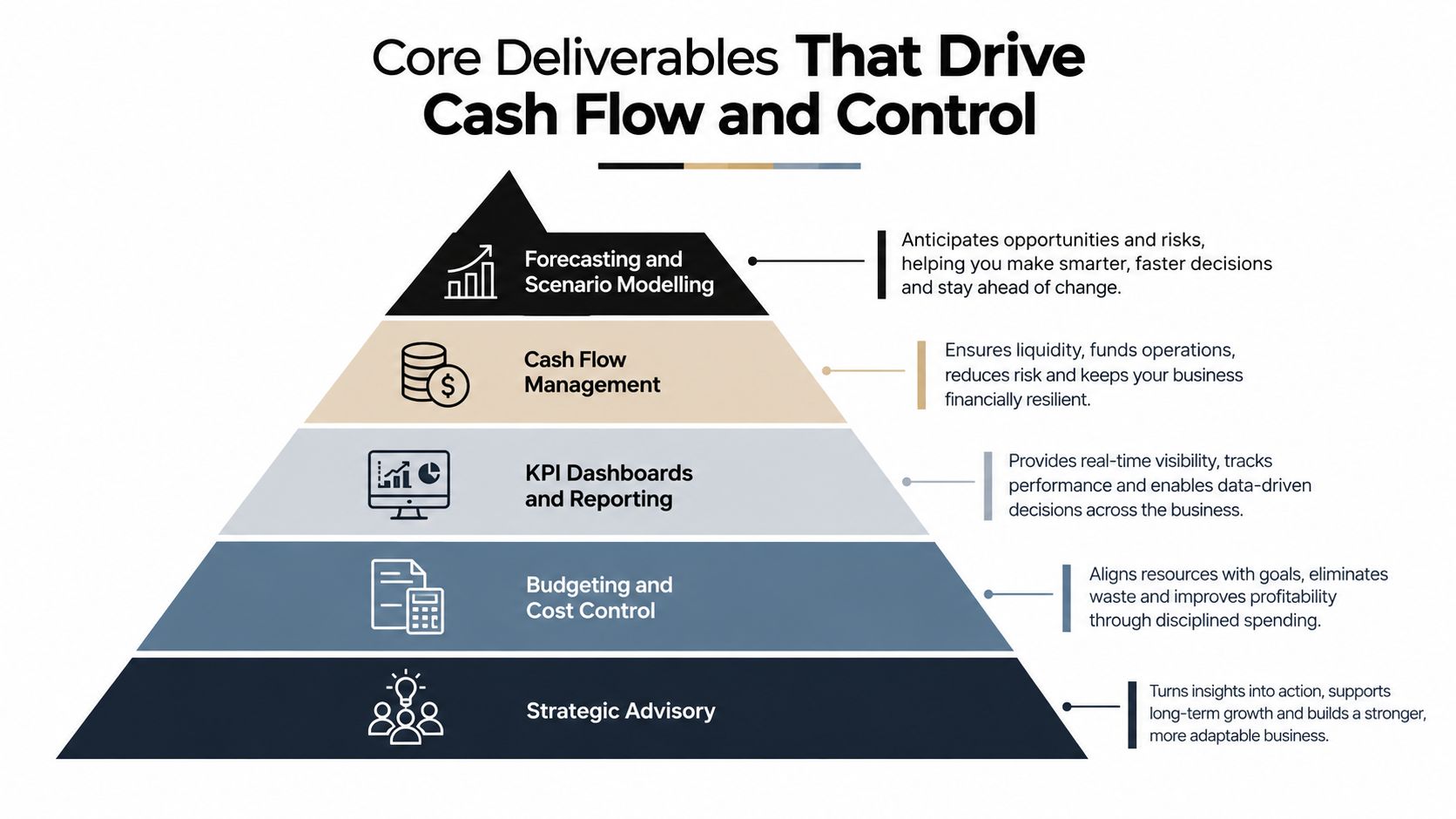
Forecasting and scenario modelling
A useful forecast isn't a static annual budget that becomes irrelevant after conditions change. It should show expected cash receipts, supplier payments, payroll, tax obligations, debt repayments, stock purchases and planned investment.
The CFO can model practical alternatives. What happens if a large customer pays late? What if stock is reordered now rather than next month? What if the business reduces discretionary spending or changes payment terms? Scenario modelling gives the owner a way to decide before the problem becomes urgent.
Cash flow management and working capital
Working capital is the cash tied up while the business waits to collect invoices or convert stock into sales. The CFO examines days sales outstanding, inventory days and the cash conversion cycle, then assigns actions to the people responsible.
Australian benchmarks show why this work deserves attention. Across 500 public companies, the median cash conversion cycle rose from 58 days in FY21 to 71 days in FY24, before improving to 62 days in FY25. Smaller companies under AU$100 million in revenue still recorded a higher 80-day median cycle in FY25, according to KPMG's Australian working capital trends report.
For an SME, intervention may involve reducing slow-moving stock, changing reorder points, collecting overdue invoices or negotiating supplier timing. The outcome isn't an abstract efficiency score. It's cash released without automatically seeking external finance.
KPI dashboards and performance reporting
A CFO dashboard should answer operational questions, not display every available metric. Useful measures may include gross margin by product or customer, contribution after freight, debtor ageing, stock turn, cash balance, forecast variance and order profitability.
The report should arrive on a predictable cadence, with commentary that identifies the decision required. A number without an owner is only information. A number linked to a deadline and action becomes control.
For a deeper explanation of the broader role, see CFO job responsibilities and strategic finance leadership.
Bookkeeping oversight, invoicing and collections
Late payments are one of the fastest ways for a profitable SME to become cash constrained. A CFO can establish invoice approval rules, payment terms, debtor ageing reviews, reminder sequences, escalation points and ownership for each overdue account.
Australian SME data illustrates the scale of the problem. A 2025 survey estimated average late-payment losses of AU$2,408 per month per SME, or nearly AU$29,000 per year, while 17% of SMBs reportedly lost more than AU$2,500 per month. Another 2025 report found that 63% of Australian SMBs experienced monthly financial losses from late payments and spent about 1.5 hours each week chasing them, equivalent to roughly 78 hours annually. These figures are reported in Airwallex's analysis of late-payment impact.
Inventory, debt and process design
Inventory controls should connect purchasing to demand, margin and cash capacity. The CFO can identify aged stock, review purchase approvals, set reorder logic and separate strategic stock from stock bought because a discount looked attractive.
Debt management receives the same treatment. The focus isn't merely on making repayments, but on understanding timing, covenants, interest exposure and whether borrowing is funding productive growth or covering a recurring cash leak.
Process redesign can reduce the cost of the finance function. PwC Australia reports that automation and process improvement can reduce costs across many key finance processes by 35% to 46%, as described in its finance effectiveness benchmark study. In practical terms, that may mean automating invoice-to-cash, payables controls, reconciliations and management reporting, while reserving human attention for judgement and exceptions.
The best engagement treats these deliverables as one finance engine. Forecasting identifies pressure, reporting explains it, and disciplined execution moves cash back into the bank.
Outsourced Versus In House CFO Which Model Fits Your Stage
A full-time CFO and an outsourced CFO can both provide senior financial leadership. The difference is how much capacity, continuity and fixed overhead the business needs.
A permanent hire may make sense when finance leadership requires continuous internal presence, broad team management and daily involvement in complex transactions. An outsourced arrangement may be more suitable when the company needs experienced judgement, but only for defined priorities and a flexible amount of time.
Criteria | Outsourced CFO | Full-Time In-House CFO |
|---|---|---|
Cost structure | Variable retainer or project cost aligned to scope | Permanent salary plus employment overhead |
Coverage | Access to agreed CFO expertise and specialist support | One executive with continuous internal availability |
Flexibility | Scope can expand, narrow or change with business priorities | Role is harder to resize after hiring |
Experience | May bring cross-industry patterns and systems knowledge | Builds deep knowledge of one business |
Implementation | Works with the existing team and external advisers | Can directly manage an internal finance team |
Risk | Requires clear access, ownership and communication routines | Carries concentration risk around one senior hire |
The decision shouldn't be based on title prestige. It should be based on the bottleneck. If overdue receivables and uncontrolled stock are absorbing cash, choose the model that will fix those systems. If the business needs a permanent finance department with daily executive management, an internal role may eventually be appropriate.
A practical decision matrix
Business situation | Likely fit |
|---|---|
Finance records are current, but the owner lacks forward visibility | Outsourced CFO |
Inventory and debtor problems need focused intervention | Outsourced CFO or project-led engagement |
The business needs continuous leadership of a sizeable finance team | Full-time CFO |
The company is between an operational finance manager and a permanent executive | Hybrid or transitional outsourced model |
A funding, acquisition or restructuring project has a defined scope | Outsourced CFO project support |
Outsourcing also doesn't mean surrendering control. The owner should retain approval rights, access to bank and accounting systems, and visibility over the forecast assumptions. The provider supplies structure and challenge, while management retains decision authority.
For terminology and engagement models, what a fractional CFO does provides useful context. The right choice is the arrangement that gives the business enough financial judgement to act decisively without carrying capacity it doesn't yet need.
How Pricing Works and What Australian SMEs Typically Pay
Outsourced CFO pricing usually follows one of three structures. The choice affects predictability, access and how clearly both sides define the work.

Monthly retainers
A monthly retainer provides ongoing access for an agreed scope. It may include a recurring forecast, management reporting, cash meetings, KPI review, collections oversight and strategic advice. This structure suits owners who need a consistent operating rhythm rather than occasional analysis.
The risk is vague scope. Before signing, clarify meeting frequency, response expectations, deliverables, implementation responsibilities and what happens when a project falls outside the regular service.
Tiered packages
Tiered packages group services by level of involvement. An entry package may focus on reporting and forecasting. A broader package may add working-capital management, process redesign and team oversight. A higher-touch arrangement may include systems implementation, lender support or intensive turnaround work.
Tiering helps a business start with its most urgent cash problem and add capacity as complexity grows. It also makes comparisons easier, provided each provider defines the time and outcomes included.
Day rates and project pricing
A day-rate structure can suit a defined review, financial model, systems cleanup or working-capital project. It gives the owner flexibility, but the project needs a clear output and completion point. Otherwise, a short intervention can become an open-ended advisory relationship.
Price generally rises with transaction volume, inventory complexity, number of entities, reporting requirements, system problems and implementation scope. The cheapest quote may only cover reporting, while a higher quote may include the people and processes required to turn the report into cash recovery.
Buying test: Ask which recurring cash leak the engagement will address, how progress will be measured, and who owns the follow-through.
Founders comparing finance support should also separate CFO work from bookkeeping administration. This bookkeeping service cost guide can help clarify the underlying bookkeeping component before you compare a broader CFO proposal.
Judge value by decisions improved and cash controls installed, not by hours billed. A provider who builds a collections routine or prevents unnecessary stock purchases may create more value than one who produces a polished report with no operational owner.
How to Choose the Right Outsourced CFO Provider
The provider needs to understand both finance and the way your business makes and spends cash. A technically capable CFO without inventory, supply chain or operational experience may miss the reason cash keeps disappearing from the bank account.

Start with technical credibility
Ask about CPA credentials, commercial finance experience and the types of businesses the provider has supported. Credentials don't replace judgement, but they help establish a foundation for accurate reporting, controls and financial interpretation.
Then test practical knowledge. Ask the provider to explain how they would investigate a profitable business with weak cash flow. A strong answer should touch on receivables, inventory, supplier terms, margins, debt timing and forecast quality, rather than recommending more reports immediately.
Check execution capability
Some providers advise. Others also implement. You need to know which one you're buying.
Ask:
Collections ownership: Who creates the debtor routine, follows up invoices and escalates disputes?
Inventory experience: How will the provider identify aged stock, reorder risk and margin erosion?
Systems approach: Can they work with tools such as Xero, MYOB, Shopify, Cin7, inventory platforms, payroll systems and reporting tools?
Automation judgement: Which finance tasks should be automated first, and which require human review?
Communication rhythm: How often will you meet, and who can answer urgent cash questions?
Success measures: What will be assessed during the first review period?
AI capability deserves specific attention. In 2025, 80% of Australian small businesses were reported to be using or planning to adopt AI, while 71% of small accounting businesses already used AI tools and another 14% planned to adopt them soon, according to BizCover's report on accounting businesses adapting to AI. MYOB also rolled out AI features for BAS, insights, invoicing and smart invoice reminders in 2026, making automation relevant to payment follow-up as well as analysis.
The provider should explain how AI will be governed. Automation can draft reminders, classify transactions and flag anomalies, but a person still needs to review unusual customers, disputed invoices, stock commitments and commercially sensitive decisions.
Look for a measurable onboarding plan
The first stage should establish data access, reporting definitions, bank and debtor visibility, inventory information and decision ownership. A practical provider may begin with a business scorecard, then produce a prioritised roadmap and implement the highest-value controls.
For broader growth and implementation support, business growth consulting services can provide useful context when comparing a CFO engagement with wider operational assistance.
Red flags include guaranteed outcomes without reviewing your data, unclear deliverables, no discussion of collections or inventory, and a heavy focus on presentation without implementation. Choose the person who can explain what they'll do on Monday morning, not only what the final dashboard will look like.
When to Engage and What Happens Next
You don't need to wait for a crisis. Engage an outsourced CFO when the business shows patterns that ordinary finance administration can't resolve.
Common signals include:
Persistent cash pressure: Sales are healthy, but the bank balance remains unpredictable.
Profit trapped in stock: Purchasing decisions are absorbing funds before demand is proven.
Late payments threatening operations: Customers owe money while payroll, suppliers or debt repayments approach.
Growth without control: Revenue, staff or complexity has increased faster than reporting and processes.
Owner overload: You spend too much time chasing invoices, checking spreadsheets and solving recurring finance problems.
The first step should be diagnostic, not a long-term commitment made from a sales presentation. The provider reviews the financial records, cash movements, debtor ageing, inventory position, reporting quality and current systems. From there, the business can create a short roadmap with immediate cash actions, control improvements and longer-term finance priorities.
AI and automation should enter after the process is understood. Automating a broken collections workflow only makes the wrong process run faster. A CFO should first define approval rules, reminder timing, escalation ownership and review points, then select the tools that support those decisions.
The right outsourced CFO gives the owner more than financial visibility. It creates a repeatable way to move from watchman, constantly checking for problems, to visionary, making informed choices about the next stage of the business. If cash is trapped in stock, receivables or inefficient processes, the best time to investigate is before the next shortage forces your hand.
Nexist helps Australian founders combine forecasting, cash-flow management, KPI reporting, collections routines, inventory controls and finance automation in one practical operating system. Visit Nexist to explore a Business Scorecard and discuss how to recover cash, strengthen control and reclaim time without adding a full-time CFO overhead.
outsourced cfo services, virtual CFO Australia, CFO services pricing, cash flow management, SME finance strategy

" width="24px"/><g d="M 0 24.129 L 0 0.129 L 24 0.129 L 24 24.129 Z M 0 24.129 L 0 0.129 L 24 0.129 L 24 24.129 Z M 24 3 C 24 1.344 22.656 0 21 0 L 3 0 C 1.344 0 0 1.344 0 3 L 0 21 C 0 22.656 1.344 24 3 24 L 21 24 C 22.656 24 24 22.656 24 21 Z M 6.883 8.375 L 2.863 8.375 L 2.863 20.467 L 6.883 20.467 Z M 4.899 2.545 C 3.524 2.545 2.625 3.449 2.625 4.634 C 2.625 5.795 3.496 6.724 4.846 6.724 L 4.872 6.724 C 6.273 6.724 7.146 5.795 7.146 4.634 C 7.12 3.449 6.274 2.545 4.899 2.545 Z M 16.747 8.09 C 14.614 8.09 13.659 9.263 13.124 10.086 L 13.124 8.374 L 9.105 8.374 C 9.159 9.508 9.105 20.466 9.105 20.466 L 13.124 20.466 L 13.124 13.713 C 13.124 13.352 13.15 12.99 13.257 12.732 C 13.547 12.01 14.209 11.262 15.319 11.262 C 16.773 11.262 17.355 12.372 17.355 13.996 L 17.355 20.466 L 21.374 20.466 L 21.374 13.532 C 21.374 9.818 19.391 8.09 16.747 8.09 Z" fill="transparent" height="24.12890599668026px" id="dSFdkJotL" width="24px"><path d="M 0 24 L 0 0 L 24 0 L 24 24 Z" fill="transparent" height="24px" id="wscNJE44G" transform="translate(0 0.129)" width="24px"/><g d="M 0 24.129 L 0 0.129 L 24 0.129 L 24 24.129 Z M 24 3 C 24 1.344 22.656 0 21 0 L 3 0 C 1.344 0 0 1.344 0 3 L 0 21 C 0 22.656 1.344 24 3 24 L 21 24 C 22.656 24 24 22.656 24 21 Z M 6.883 8.375 L 2.863 8.375 L 2.863 20.467 L 6.883 20.467 Z M 4.899 2.545 C 3.524 2.545 2.625 3.449 2.625 4.634 C 2.625 5.795 3.496 6.724 4.846 6.724 L 4.872 6.724 C 6.273 6.724 7.146 5.795 7.146 4.634 C 7.12 3.449 6.274 2.545 4.899 2.545 Z M 16.747 8.09 C 14.614 8.09 13.659 9.263 13.124 10.086 L 13.124 8.374 L 9.105 8.374 C 9.159 9.508 9.105 20.466 9.105 20.466 L 13.124 20.466 L 13.124 13.713 C 13.124 13.352 13.15 12.99 13.257 12.732 C 13.547 12.01 14.209 11.262 15.319 11.262 C 16.773 11.262 17.355 12.372 17.355 13.996 L 17.355 20.466 L 21.374 20.466 L 21.374 13.532 C 21.374 9.818 19.391 8.09 16.747 8.09 Z" fill="transparent" height="24.12890599668026px" id="sTpjGo1tb" width="24px"><path d="M 0 24 L 0 0 L 24 0 L 24 24 Z" fill="transparent" height="24px" id="s7ffpmKOD" transform="translate(0 0.129)" width="24px"/><g d="M 24 3 C 24 1.344 22.656 0 21 0 L 3 0 C 1.344 0 0 1.344 0 3 L 0 21 C 0 22.656 1.344 24 3 24 L 21 24 C 22.656 24 24 22.656 24 21 Z M 6.883 8.375 L 2.863 8.375 L 2.863 20.467 L 6.883 20.467 Z M 4.899 2.545 C 3.524 2.545 2.625 3.449 2.625 4.634 C 2.625 5.795 3.496 6.724 4.846 6.724 L 4.872 6.724 C 6.273 6.724 7.146 5.795 7.146 4.634 C 7.12 3.449 6.274 2.545 4.899 2.545 Z M 16.747 8.09 C 14.614 8.09 13.659 9.263 13.124 10.086 L 13.124 8.374 L 9.105 8.374 C 9.159 9.508 9.105 20.466 9.105 20.466 L 13.124 20.466 L 13.124 13.713 C 13.124 13.352 13.15 12.99 13.257 12.732 C 13.547 12.01 14.209 11.262 15.319 11.262 C 16.773 11.262 17.355 12.372 17.355 13.996 L 17.355 20.466 L 21.374 20.466 L 21.374 13.532 C 21.374 9.818 19.391 8.09 16.747 8.09 Z" fill="transparent" height="24.000006px" id="D0ecaHEcW" transform="translate(0 0)" width="24px"><path d="M 24 3 C 24 1.344 22.656 0 21 0 L 3 0 C 1.344 0 0 1.344 0 3 L 0 21 C 0 22.656 1.344 24 3 24 L 21 24 C 22.656 24 24 22.656 24 21 Z" fill="rgb(55, 184, 218)" height="24.000006px" id="IPLFE6zXx" width="24px"/><path d="M 4.02 0 L 0 0 L 0 12.092 L 4.02 12.092 Z" fill="rgb(255, 255, 255)" height="12.09201px" id="FWhtzAyuY" transform="translate(2.863 8.375)" width="4.02px"/><path d="M 2.274 0 C 0.899 0 0 0.904 0 2.089 C 0 3.25 0.871 4.179 2.221 4.179 L 2.247 4.179 C 3.648 4.179 4.521 3.25 4.521 2.089 C 4.495 0.904 3.649 0 2.274 0 Z" fill="rgb(255, 255, 255)" height="4.17876px" id="VmOsKv4kO" transform="translate(2.625 2.545)" width="4.52095px"/><path d="M 7.641 0 C 5.509 0 4.554 1.173 4.019 1.996 L 4.019 0.284 L 0 0.284 C 0.053 1.419 0 12.376 0 12.376 L 4.019 12.376 L 4.019 5.623 C 4.019 5.262 4.045 4.9 4.151 4.642 C 4.442 3.92 5.103 3.172 6.214 3.172 C 7.667 3.172 8.25 4.282 8.25 5.907 L 8.25 12.376 L 12.269 12.376 L 12.269 5.442 C 12.269 1.728 10.286 0 7.641 0 Z" fill="rgb(255, 255, 255)" height="12.37626px" id="n1XUbhaq0" transform="translate(9.105 8.09)" width="12.268830000000001px"/></g></g></g></g></svg>)